

Post-Treatment Checks in Hertfordshire: How Do You Know Moisture Control Is Working?
Completing damp or timber treatment is an important milestone, but it does not always mean the property has immediately returned to normal. Walls can retain moisture, timber may need time to dry and hidden defects can sometimes become clearer as the building settles.

Why you can trust our content
At a glance
For homeowners, the key question is not simply whether a damp patch has disappeared. It is whether the source of moisture has been controlled and whether the affected parts of the building are responding as expected.
Post-treatment checks provide an opportunity to look at moisture levels, surface condition, timber and any relevant external or internal defects before the next stage of repairs or redecoration begins.
If you are unsure whether previous remedial work has achieved the intended result, Anke Damp Proofing can assess the affected areas and explain what the findings mean for the next stage.
What should you expect after damp treatment?
The property may not look completely normal immediately after treatment. Drying can take time, particularly where masonry, plaster or timber has absorbed moisture over an extended period.
The drying process is influenced by:
- The construction and thickness of the affected wall
- How much moisture was present
- The materials surrounding the affected area
- Ventilation and air movement
- Heating conditions
- External weather
- The effectiveness of the original moisture-control measures
This is why damp proofing hertfordshire should be followed by appropriate observation rather than an assumption that every visible sign must disappear immediately.
A gradual reduction in moisture, stable surfaces and no evidence of renewed water ingress can provide useful indications that conditions are improving.
Which signs suggest moisture control is working?
Several changes can suggest that the building is responding positively after treatment.
These can include:
- Moisture readings gradually reducing.
- Damp staining becoming less noticeable.
- Salt deposits becoming less active.
- Paint and plaster remaining stable.
- Musty smells reducing.
- Previously affected timber remaining sound.
- No new areas of moisture appearing.
None of these signs should be considered in isolation. A wall may look dry on the surface while still retaining moisture deeper within the construction.
Likewise, old staining can remain visible after the moisture source has been controlled. What matters is whether the overall condition is stable or improving.
How can a follow-up survey help?
A damp survey hertfordshire can provide a structured assessment where there is uncertainty about drying progress or the effectiveness of previous remedial work.
A follow-up survey may compare the current condition with earlier findings and examine areas that were previously affected. Depending on the property, this could include walls, floors, timber, plaster, external elevations and relevant ventilation.
Testing should always be interpreted in context. Different materials can produce different readings, and a moisture meter is not, by itself, a complete diagnosis.
What should be checked around previously affected walls?
A post-treatment inspection should look beyond the original damp patch.
Useful checks can include:
| Area | What to check | What the finding may indicate |
| Wall surface | Staining, salts and finish condition | Whether the surface is stabilising |
| Wall moisture | Consistent readings in relevant areas | Drying or continued moisture |
| Skirting | Swelling, softness or damage | Possible continuing damp |
| Plaster | Cracking, blistering or deterioration | Moisture or material issues |
| External wall | Pointing, render and drainage | Potential water entry |
| Gutters and downpipes | Leaks or blockages | Possible recurring water ingress |
| Ventilation | Airflow and moisture control | Ability of the property to dry |
This wider inspection matters because moisture can travel through building materials. The location of a visible symptom is not necessarily the location where water entered the property.
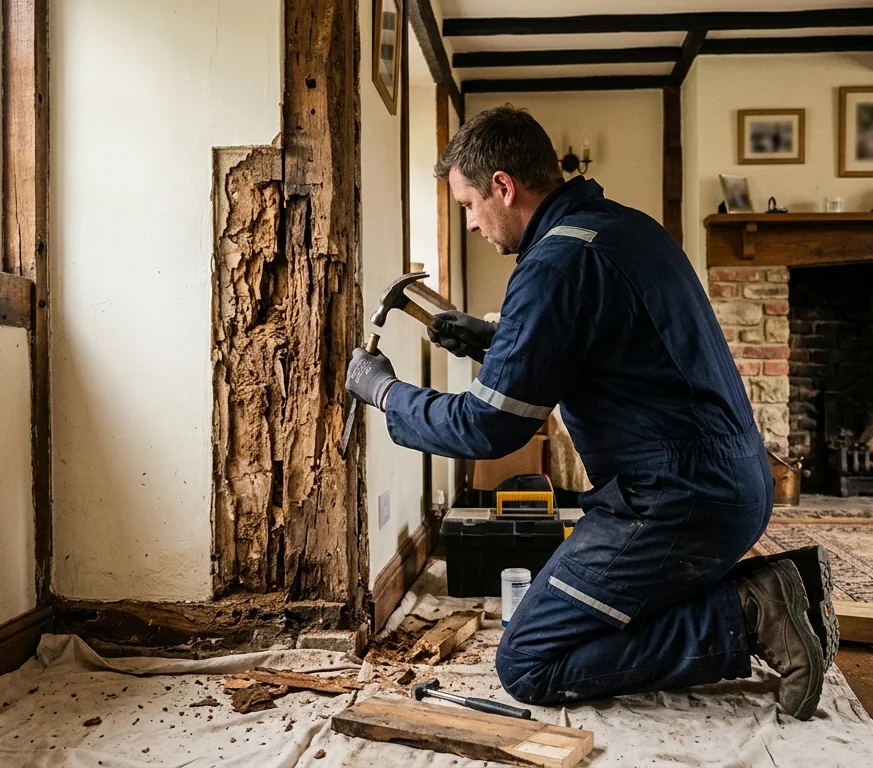
What about timber after rot treatment?
Timber should be assessed according to both its current condition and the environment around it.
After dry rot treatment hertfordshire, checks should establish whether the timber and surrounding area are sufficiently dry and whether the original conditions that supported fungal decay have been controlled.
With wet rot treatment hertfordshire, controlling moisture remains particularly important because prolonged dampness is closely associated with the development of wet rot.
Follow-up attention may include:
- Timber moisture levels
- Soft or deteriorated areas
- Previously damaged sections
- Repaired or replaced timber
- Concealed areas where practical
- Nearby sources of water
- Ventilation around timber
A mark on timber does not automatically mean decay is continuing. Older staining and discolouration can remain after the underlying moisture problem has been resolved.
What best describes you?

Homeowner

Tenant

Management/Lettings Agent

Potential Buyer

Other
It just takes 60 Second
And then you can book a free consultation
Could a treated property still have high moisture readings?
Yes. Retained moisture can remain within masonry, plaster and timber after the original source has been addressed.
This does not automatically mean the treatment has failed. The important consideration is whether readings are consistent with a drying building and whether there are any additional signs of active moisture.
Repeated readings can be more informative than a single measurement because they show whether conditions are changing.
Where readings remain elevated without improvement, further investigation may be appropriate.
If moisture readings are not behaving as expected, avoid simply covering the affected surface with a new finish. Anke Damp Proofing can review the area and help determine whether additional investigation is needed.
What external problems can cause damp to return?
Moisture control inside a property can be undermined by defects outside the building.
Common examples include:
- Blocked or leaking gutters
- Damaged downpipes
- Defective pointing
- Cracked render
- Roof defects
- Poor external drainage
- Bridged or damaged damp-proof details
- Defective seals around openings
For this reason, a post-treatment review may need to include relevant external areas, particularly where penetrating damp was part of the original diagnosis.
A recurrence of damp should not automatically be attributed to the original treatment. A separate building defect may have developed afterwards.
When should you arrange another inspection?
Another inspection can be useful when the property does not appear to be progressing as expected.
Consider arranging a follow-up assessment if:
- Moisture readings remain high
- New staining appears
- Existing staining becomes darker or larger
- Timber becomes softer
- Musty smells return
- Plaster or paint begins deteriorating again
- Water ingress is suspected
- The property has undergone additional building work
The timing depends on the original treatment and the building’s condition. There is no universal inspection interval suitable for every property.
Why is monitoring sometimes better than immediate further treatment?
Not every persistent symptom requires another treatment immediately.
If moisture levels are gradually falling and there is no evidence of active water ingress or continuing timber deterioration, allowing the property additional time to dry may be appropriate.
Monitoring provides useful evidence of whether the situation is changing.
A simple record can include:
- Inspection dates
- Areas tested
- Moisture readings
- Visible changes
- Timber condition
- Any new water-related defects
- Changes to ventilation or heating
This information can help establish a clearer picture of the property’s progress.
A typical Hertfordshire example
Consider a semi-detached house where moisture has affected a ground-floor wall following an external defect. Once the source is addressed, damaged finishes are removed and remedial work is completed.
At the first follow-up, the wall still records some moisture, but staining is fading and there is no evidence of new water ingress. The surrounding timber is stable and the room has adequate ventilation.
Rather than assuming the treatment has failed, the homeowner continues monitoring while the masonry dries. A later assessment shows that moisture levels have reduced further and the surface remains stable.
The example demonstrates why post-treatment assessment should focus on the direction of change rather than expecting an instant return to completely dry materials.
What does a good post-treatment record contain?
A clear record can make future decisions easier, particularly if the property requires additional work later.
A useful assessment may document:
- The areas inspected
- Moisture readings where appropriate
- Visible condition of walls and finishes
- Timber condition
- Previous remedial work
- Potential moisture sources
- Photographs
- Recommended drying or monitoring
- Any defects requiring attention
- Advice about reinstatement
A damp proofing specialist should be able to explain the findings in straightforward terms and distinguish between evidence of drying and signs that warrant further investigation.
What should you avoid after remedial work?
It can be tempting to complete the decorative work as quickly as possible once the property looks better. However, several actions can make future assessment more difficult.
Avoid:
- Painting over persistent damp staining
- Covering questionable timber before it has been checked
- Ignoring new smells or visible deterioration
- Assuming a single moisture reading tells the entire story
- Treating recurring symptoms without investigating their source
- Blocking ventilation around previously affected areas
Allowing the building to dry and keeping relevant areas accessible for inspection can make it easier to identify whether moisture control is working.
Conclusion: Measure Progress Before Moving On
Post-treatment checks are about establishing whether the property is genuinely improving, not simply whether the original damp patch looks better.
Moisture readings, surface condition, timber stability, ventilation and potential external defects can all provide useful evidence. If the building is drying steadily and no new problems are appearing, that can provide reassurance. If conditions remain unchanged or deteriorate, further investigation can identify what needs attention.
For homeowners who want a clearer picture of their property’s condition after damp or timber treatment, Anke Damp Proofing can provide practical, evidence-based guidance. Contact the team to discuss a follow-up assessment or request a bespoke quote.
Related articles


What best describes you?
Homeowner
Tenant
Management/Lettings Agent
Potential Buyer
Other
At a glance
For homeowners, the key question is not simply whether a damp patch has disappeared. It is whether the source of moisture has been controlled and whether the affected parts of the building are responding as expected.
Post-treatment checks provide an opportunity to look at moisture levels, surface condition, timber and any relevant external or internal defects before the next stage of repairs or redecoration begins.
If you are unsure whether previous remedial work has achieved the intended result, Anke Damp Proofing can assess the affected areas and explain what the findings mean for the next stage.
What should you expect after damp treatment?
The property may not look completely normal immediately after treatment. Drying can take time, particularly where masonry, plaster or timber has absorbed moisture over an extended period.
The drying process is influenced by:
- The construction and thickness of the affected wall
- How much moisture was present
- The materials surrounding the affected area
- Ventilation and air movement
- Heating conditions
- External weather
- The effectiveness of the original moisture-control measures
This is why damp proofing hertfordshire should be followed by appropriate observation rather than an assumption that every visible sign must disappear immediately.
A gradual reduction in moisture, stable surfaces and no evidence of renewed water ingress can provide useful indications that conditions are improving.
Which signs suggest moisture control is working?
Several changes can suggest that the building is responding positively after treatment.
These can include:
- Moisture readings gradually reducing.
- Damp staining becoming less noticeable.
- Salt deposits becoming less active.
- Paint and plaster remaining stable.
- Musty smells reducing.
- Previously affected timber remaining sound.
- No new areas of moisture appearing.
None of these signs should be considered in isolation. A wall may look dry on the surface while still retaining moisture deeper within the construction.
Likewise, old staining can remain visible after the moisture source has been controlled. What matters is whether the overall condition is stable or improving.
How can a follow-up survey help?
A damp survey hertfordshire can provide a structured assessment where there is uncertainty about drying progress or the effectiveness of previous remedial work.
A follow-up survey may compare the current condition with earlier findings and examine areas that were previously affected. Depending on the property, this could include walls, floors, timber, plaster, external elevations and relevant ventilation.
Testing should always be interpreted in context. Different materials can produce different readings, and a moisture meter is not, by itself, a complete diagnosis.
What should be checked around previously affected walls?
A post-treatment inspection should look beyond the original damp patch.
Useful checks can include:
| Area | What to check | What the finding may indicate |
| Wall surface | Staining, salts and finish condition | Whether the surface is stabilising |
| Wall moisture | Consistent readings in relevant areas | Drying or continued moisture |
| Skirting | Swelling, softness or damage | Possible continuing damp |
| Plaster | Cracking, blistering or deterioration | Moisture or material issues |
| External wall | Pointing, render and drainage | Potential water entry |
| Gutters and downpipes | Leaks or blockages | Possible recurring water ingress |
| Ventilation | Airflow and moisture control | Ability of the property to dry |
This wider inspection matters because moisture can travel through building materials. The location of a visible symptom is not necessarily the location where water entered the property.
What about timber after rot treatment?
Timber should be assessed according to both its current condition and the environment around it.
After dry rot treatment hertfordshire, checks should establish whether the timber and surrounding area are sufficiently dry and whether the original conditions that supported fungal decay have been controlled.
With wet rot treatment hertfordshire, controlling moisture remains particularly important because prolonged dampness is closely associated with the development of wet rot.
Follow-up attention may include:
- Timber moisture levels
- Soft or deteriorated areas
- Previously damaged sections
- Repaired or replaced timber
- Concealed areas where practical
- Nearby sources of water
- Ventilation around timber
A mark on timber does not automatically mean decay is continuing. Older staining and discolouration can remain after the underlying moisture problem has been resolved.
What best describes you?
Homeowner
Tenant
Management/Lettings Agent
Potential Buyer
Other
It just takes 60 Second
And then you can book a free consultation
Could a treated property still have high moisture readings?
Yes. Retained moisture can remain within masonry, plaster and timber after the original source has been addressed.
This does not automatically mean the treatment has failed. The important consideration is whether readings are consistent with a drying building and whether there are any additional signs of active moisture.
Repeated readings can be more informative than a single measurement because they show whether conditions are changing.
Where readings remain elevated without improvement, further investigation may be appropriate.
If moisture readings are not behaving as expected, avoid simply covering the affected surface with a new finish. Anke Damp Proofing can review the area and help determine whether additional investigation is needed.
What external problems can cause damp to return?
Moisture control inside a property can be undermined by defects outside the building.
Common examples include:
- Blocked or leaking gutters
- Damaged downpipes
- Defective pointing
- Cracked render
- Roof defects
- Poor external drainage
- Bridged or damaged damp-proof details
- Defective seals around openings
For this reason, a post-treatment review may need to include relevant external areas, particularly where penetrating damp was part of the original diagnosis.
A recurrence of damp should not automatically be attributed to the original treatment. A separate building defect may have developed afterwards.
When should you arrange another inspection?
Another inspection can be useful when the property does not appear to be progressing as expected.
Consider arranging a follow-up assessment if:
- Moisture readings remain high
- New staining appears
- Existing staining becomes darker or larger
- Timber becomes softer
- Musty smells return
- Plaster or paint begins deteriorating again
- Water ingress is suspected
- The property has undergone additional building work
The timing depends on the original treatment and the building’s condition. There is no universal inspection interval suitable for every property.
Why is monitoring sometimes better than immediate further treatment?
Not every persistent symptom requires another treatment immediately.
If moisture levels are gradually falling and there is no evidence of active water ingress or continuing timber deterioration, allowing the property additional time to dry may be appropriate.
Monitoring provides useful evidence of whether the situation is changing.
A simple record can include:
- Inspection dates
- Areas tested
- Moisture readings
- Visible changes
- Timber condition
- Any new water-related defects
- Changes to ventilation or heating
This information can help establish a clearer picture of the property’s progress.
A typical Hertfordshire example
Consider a semi-detached house where moisture has affected a ground-floor wall following an external defect. Once the source is addressed, damaged finishes are removed and remedial work is completed.
At the first follow-up, the wall still records some moisture, but staining is fading and there is no evidence of new water ingress. The surrounding timber is stable and the room has adequate ventilation.
Rather than assuming the treatment has failed, the homeowner continues monitoring while the masonry dries. A later assessment shows that moisture levels have reduced further and the surface remains stable.
The example demonstrates why post-treatment assessment should focus on the direction of change rather than expecting an instant return to completely dry materials.
What does a good post-treatment record contain?
A clear record can make future decisions easier, particularly if the property requires additional work later.
A useful assessment may document:
- The areas inspected
- Moisture readings where appropriate
- Visible condition of walls and finishes
- Timber condition
- Previous remedial work
- Potential moisture sources
- Photographs
- Recommended drying or monitoring
- Any defects requiring attention
- Advice about reinstatement
A damp proofing specialist should be able to explain the findings in straightforward terms and distinguish between evidence of drying and signs that warrant further investigation.
What should you avoid after remedial work?
It can be tempting to complete the decorative work as quickly as possible once the property looks better. However, several actions can make future assessment more difficult.
Avoid:
- Painting over persistent damp staining
- Covering questionable timber before it has been checked
- Ignoring new smells or visible deterioration
- Assuming a single moisture reading tells the entire story
- Treating recurring symptoms without investigating their source
- Blocking ventilation around previously affected areas
Allowing the building to dry and keeping relevant areas accessible for inspection can make it easier to identify whether moisture control is working.
Conclusion: Measure Progress Before Moving On
Post-treatment checks are about establishing whether the property is genuinely improving, not simply whether the original damp patch looks better.
Moisture readings, surface condition, timber stability, ventilation and potential external defects can all provide useful evidence. If the building is drying steadily and no new problems are appearing, that can provide reassurance. If conditions remain unchanged or deteriorate, further investigation can identify what needs attention.
For homeowners who want a clearer picture of their property’s condition after damp or timber treatment, Anke Damp Proofing can provide practical, evidence-based guidance. Contact the team to discuss a follow-up assessment or request a bespoke quote.
Related articles
What best describes you?
Homeowner
Tenant
Management/Lettings Agent
Potential Buyer