

How Long Should East London Timber Dry After Rot Treatment – and What Should a Follow-Up Report Record?
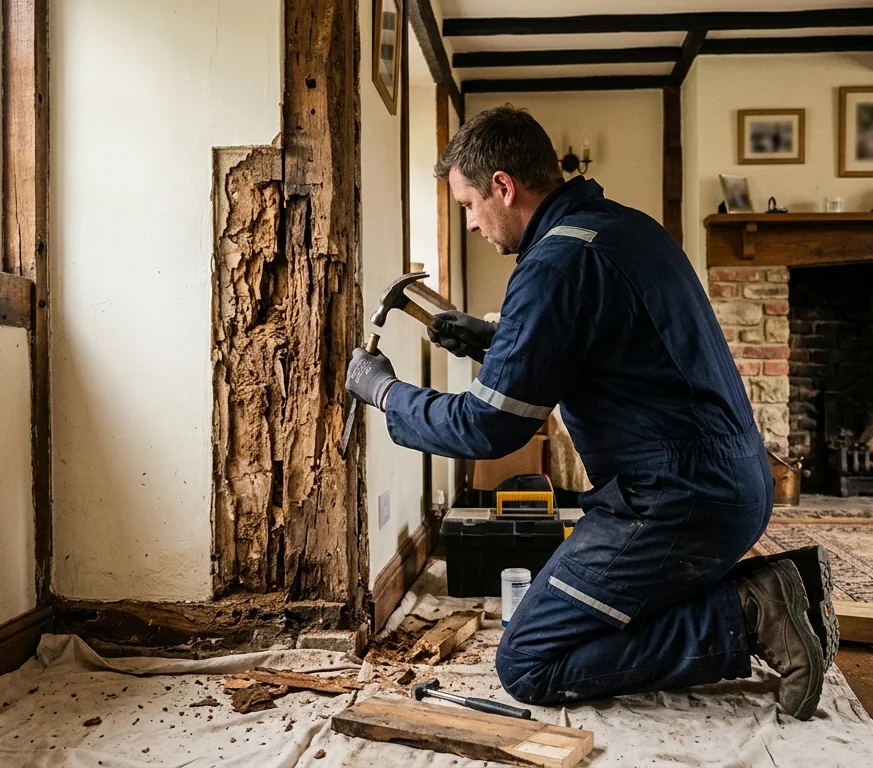
Treating timber affected by rot is only part of the remedial process. Once the source of excess moisture has been addressed and affected timber has been treated or replaced, the next question is whether the remaining wood has dried sufficiently and whether the conditions that caused the decay are under control.

Why you can trust our content
At a glance
There is no single drying period that applies to every property. A Victorian terrace, converted flat and modern house can behave very differently depending on construction, ventilation, timber dimensions and the amount of moisture present.
For homeowners arranging damp proofing east london, understanding what happens after treatment can make it easier to judge when follow-up inspection and reinstatement should take place.
If you are uncertain about the condition of timber after remedial work, Anke Damp Proofing can help assess the affected areas and explain what should be checked before further repairs or redecoration.
How long does timber normally take to dry after rot treatment?
Timber can take weeks or considerably longer to reach a stable moisture condition, depending on the building and the original source of damp. Thick structural timbers generally dry more slowly than small sections, while poorly ventilated spaces can retain moisture for much longer.
Factors that influence drying include:
- Timber species and dimensions
- Initial moisture content
- Wall and floor construction
- Air movement around the timber
- Heating and ventilation
- External weather conditions
- Whether the moisture source has been completely controlled
- Whether surrounding masonry or plaster remains damp
A professional should therefore avoid giving an arbitrary drying deadline without considering the actual building.
A damp survey east london can provide useful information where there is uncertainty about the wider moisture conditions affecting timber. The assessment should consider the building as a whole rather than treating a timber reading in isolation.
What happens to timber after rot treatment?
Once the moisture source has been controlled, timber should generally move towards a lower and more stable moisture content. However, this does not necessarily happen immediately.
The surrounding masonry can continue releasing retained moisture, particularly where a wall or floor has been wet for an extended period. Timber positioned against or within these materials may therefore take longer to dry.
After dry rot treatment east london, the important question is whether the environment remains suitable for the timber to stay dry. Dry rot is associated with damp conditions, so controlling moisture is an essential part of protecting the property after treatment.
With wet rot treatment east london, the same principle applies. Wet rot is closely associated with prolonged moisture exposure, meaning the underlying source needs attention rather than relying solely on treatment to the affected wood.
Which factors can slow timber drying?
Drying is affected by both the timber itself and the environment around it.
Restricted airflow
Timber hidden behind finishes, beneath floors or within enclosed spaces may receive very little air movement. This can slow evaporation considerably.
Damp surrounding materials
If masonry, plaster or flooring remains wet, moisture can continue moving towards nearby timber.
Continued water ingress
A leaking gutter, defective roof detail or plumbing problem can prevent timber from drying even after other remedial work has been completed.
Poor ventilation
Bathrooms, kitchens, basements and enclosed areas can have higher moisture levels. Without appropriate ventilation, the drying process can be prolonged.
Cold conditions
Lower temperatures can affect evaporation and reduce the effectiveness of natural drying. Seasonal conditions should therefore be considered when interpreting progress.
What should be measured during a follow-up inspection?
A follow-up inspection should establish whether the timber is drying and whether there is evidence of continuing deterioration.
Depending on the circumstances, an inspection may consider:
| Inspection area | What may be recorded | Why it matters |
| Timber moisture | Readings from relevant areas | Shows drying progress |
| Timber condition | Softness, cracking or deterioration | Identifies ongoing damage |
| Previously affected areas | Changes since treatment | Helps establish whether conditions are improving |
| Surrounding materials | Dampness or staining | May indicate retained moisture |
| Ventilation | Air movement and moisture control | Supports continued drying |
| External defects | Gutters, pointing, roof or drainage | Helps identify recurring water ingress |
| Repairs | Work completed or still required | Creates a clear record |
Measurements should be interpreted in context. Timber moisture can naturally vary according to the season, location and construction, so a single number should not automatically be treated as proof of success or failure.
Why is a follow-up report useful?
A detailed dry rot survey and report gives the homeowner a record of what was found, what was previously treated and what condition the affected areas are in at the time of inspection.
This can be particularly useful where drying is expected to take time. Rather than relying on memory, the report can establish a baseline against which future inspections can be compared.
A useful report may include:
- Property and inspection details
- Areas examined
- Timber locations and condition
- Moisture readings where appropriate
- Visible signs of decay
- Photographs of significant areas
- Details of previous treatment
- Repairs already completed
- Remaining defects
- Recommended monitoring or remedial work
- Advice about future inspection
This information can also help if another contractor needs to carry out related work later.
When should further timber work be considered?
Further timber work may be appropriate when inspection shows that affected material remains structurally compromised, continues to deteriorate or cannot be adequately protected in its current condition.
However, replacement should not automatically be the first response to every sign of staining or moisture.
An assessment should consider:
- Whether the timber is still sound.
- Whether moisture levels are reducing.
- Whether the source of damp has been controlled.
- Whether affected timber can remain in place safely.
- Whether repairs or replacement are required.
- Whether surrounding materials are contributing to the problem.
The appropriate solution will depend on the location and role of the timber. Structural members may require different consideration from non-structural joinery.
Where timber remains soft, damp or visibly deteriorated, further assessment is preferable to simply covering it with new finishes. Anke Damp Proofing can inspect the affected area and advise whether additional treatment or timber repairs should be considered.
What best describes you?

Homeowner
Tenant

Management/Lettings Agent

Potential Buyer

Other
It just takes 60 Second
And then you can book a free consultation
What signs suggest timber may not be drying properly?
Homeowners should pay attention to changes rather than relying only on the passage of time.
Potential warning signs include:
- Moisture readings remaining consistently high
- New darkening or staining
- Persistent musty odours
- Timber becoming softer
- Crumbling or deteriorating wood
- New fungal growth
- Dampness returning after initially improving
- Water marks appearing around previously affected areas
These signs do not automatically prove that rot is active. They indicate that further investigation may be sensible.
It is also important not to confuse old staining with new deterioration. Timber can retain marks after the original moisture problem has been resolved.
What should happen before timber is covered up?
Covering timber with plasterboard, insulation, flooring or decorative finishes can make future inspection more difficult. Where timber is still being monitored, access should be maintained until the relevant professional is satisfied that the condition is stable.
This is especially important in concealed areas where a later problem could be difficult to identify.
If reinstatement is necessary, the materials and method should be suitable for the building and should not create a new moisture trap.
A typical East London example
Consider a traditional terraced property where a leaking external detail has allowed moisture to affect timber around a ground-floor opening. The damaged section is assessed, the source of water is addressed and affected timber is repaired or treated.
Several weeks later, the area appears much improved. However, the follow-up inspection finds that moisture levels are still higher than expected because the surrounding masonry has retained water.
Rather than immediately closing the area with new finishes, the property owner allows additional drying time and continues monitoring. A later inspection confirms that conditions are improving, providing greater confidence before reinstatement.
The important point is that drying was treated as a process to be measured, rather than a deadline to be guessed.
How should homeowners judge the success of rot treatment?
Successful treatment involves more than the disappearance of visible symptoms.
A sensible assessment should consider whether:
- The moisture source has been controlled.
- Timber condition is stable.
- Moisture levels are moving in the expected direction.
- There are no signs of continuing deterioration.
- Any necessary damaged timber has been repaired or replaced.
- The surrounding environment is suitable for keeping timber dry.
- Follow-up findings are properly recorded.
This provides a more reliable picture than simply asking whether the affected area looks better.
Check the Timber Before Covering It Again
The period after rot treatment is an important part of protecting a property. Timber may continue to dry for some time after the original moisture source has been addressed, and the correct timeframe depends on the individual building.
Regular, appropriate checks can establish whether moisture is reducing, timber is stable and further work is genuinely necessary. A clear follow-up report also creates a useful record of the property’s condition and any recommended next steps.
If you need reassurance about timber following damp or rot treatment, Anke Damp Proofing can provide a professional assessment and practical recommendations. Contact the team to discuss a follow-up inspection or request a bespoke quote.
Related articles

What best describes you?
Homeowner
Tenant
Management/Lettings Agent
Potential Buyer
Other
At a glance
There is no single drying period that applies to every property. A Victorian terrace, converted flat and modern house can behave very differently depending on construction, ventilation, timber dimensions and the amount of moisture present.
For homeowners arranging damp proofing east london, understanding what happens after treatment can make it easier to judge when follow-up inspection and reinstatement should take place.
If you are uncertain about the condition of timber after remedial work, Anke Damp Proofing can help assess the affected areas and explain what should be checked before further repairs or redecoration.
How long does timber normally take to dry after rot treatment?
Timber can take weeks or considerably longer to reach a stable moisture condition, depending on the building and the original source of damp. Thick structural timbers generally dry more slowly than small sections, while poorly ventilated spaces can retain moisture for much longer.
Factors that influence drying include:
- Timber species and dimensions
- Initial moisture content
- Wall and floor construction
- Air movement around the timber
- Heating and ventilation
- External weather conditions
- Whether the moisture source has been completely controlled
- Whether surrounding masonry or plaster remains damp
A professional should therefore avoid giving an arbitrary drying deadline without considering the actual building.
A damp survey east london can provide useful information where there is uncertainty about the wider moisture conditions affecting timber. The assessment should consider the building as a whole rather than treating a timber reading in isolation.
What happens to timber after rot treatment?
Once the moisture source has been controlled, timber should generally move towards a lower and more stable moisture content. However, this does not necessarily happen immediately.
The surrounding masonry can continue releasing retained moisture, particularly where a wall or floor has been wet for an extended period. Timber positioned against or within these materials may therefore take longer to dry.
After dry rot treatment east london, the important question is whether the environment remains suitable for the timber to stay dry. Dry rot is associated with damp conditions, so controlling moisture is an essential part of protecting the property after treatment.
With wet rot treatment east london, the same principle applies. Wet rot is closely associated with prolonged moisture exposure, meaning the underlying source needs attention rather than relying solely on treatment to the affected wood.
Which factors can slow timber drying?
Drying is affected by both the timber itself and the environment around it.
Restricted airflow
Timber hidden behind finishes, beneath floors or within enclosed spaces may receive very little air movement. This can slow evaporation considerably.
Damp surrounding materials
If masonry, plaster or flooring remains wet, moisture can continue moving towards nearby timber.
Continued water ingress
A leaking gutter, defective roof detail or plumbing problem can prevent timber from drying even after other remedial work has been completed.
Poor ventilation
Bathrooms, kitchens, basements and enclosed areas can have higher moisture levels. Without appropriate ventilation, the drying process can be prolonged.
Cold conditions
Lower temperatures can affect evaporation and reduce the effectiveness of natural drying. Seasonal conditions should therefore be considered when interpreting progress.
What should be measured during a follow-up inspection?
A follow-up inspection should establish whether the timber is drying and whether there is evidence of continuing deterioration.
Depending on the circumstances, an inspection may consider:
| Inspection area | What may be recorded | Why it matters |
| Timber moisture | Readings from relevant areas | Shows drying progress |
| Timber condition | Softness, cracking or deterioration | Identifies ongoing damage |
| Previously affected areas | Changes since treatment | Helps establish whether conditions are improving |
| Surrounding materials | Dampness or staining | May indicate retained moisture |
| Ventilation | Air movement and moisture control | Supports continued drying |
| External defects | Gutters, pointing, roof or drainage | Helps identify recurring water ingress |
| Repairs | Work completed or still required | Creates a clear record |
Measurements should be interpreted in context. Timber moisture can naturally vary according to the season, location and construction, so a single number should not automatically be treated as proof of success or failure.
Why is a follow-up report useful?
A detailed dry rot survey and report gives the homeowner a record of what was found, what was previously treated and what condition the affected areas are in at the time of inspection.
This can be particularly useful where drying is expected to take time. Rather than relying on memory, the report can establish a baseline against which future inspections can be compared.
A useful report may include:
- Property and inspection details
- Areas examined
- Timber locations and condition
- Moisture readings where appropriate
- Visible signs of decay
- Photographs of significant areas
- Details of previous treatment
- Repairs already completed
- Remaining defects
- Recommended monitoring or remedial work
- Advice about future inspection
This information can also help if another contractor needs to carry out related work later.
When should further timber work be considered?
Further timber work may be appropriate when inspection shows that affected material remains structurally compromised, continues to deteriorate or cannot be adequately protected in its current condition.
However, replacement should not automatically be the first response to every sign of staining or moisture.
An assessment should consider:
- Whether the timber is still sound.
- Whether moisture levels are reducing.
- Whether the source of damp has been controlled.
- Whether affected timber can remain in place safely.
- Whether repairs or replacement are required.
- Whether surrounding materials are contributing to the problem.
The appropriate solution will depend on the location and role of the timber. Structural members may require different consideration from non-structural joinery.
Where timber remains soft, damp or visibly deteriorated, further assessment is preferable to simply covering it with new finishes. Anke Damp Proofing can inspect the affected area and advise whether additional treatment or timber repairs should be considered.
What best describes you?
Homeowner
Tenant
Management/Lettings Agent
Potential Buyer
Other
It just takes 60 Second
And then you can book a free consultation
What signs suggest timber may not be drying properly?
Homeowners should pay attention to changes rather than relying only on the passage of time.
Potential warning signs include:
- Moisture readings remaining consistently high
- New darkening or staining
- Persistent musty odours
- Timber becoming softer
- Crumbling or deteriorating wood
- New fungal growth
- Dampness returning after initially improving
- Water marks appearing around previously affected areas
These signs do not automatically prove that rot is active. They indicate that further investigation may be sensible.
It is also important not to confuse old staining with new deterioration. Timber can retain marks after the original moisture problem has been resolved.
What should happen before timber is covered up?
Covering timber with plasterboard, insulation, flooring or decorative finishes can make future inspection more difficult. Where timber is still being monitored, access should be maintained until the relevant professional is satisfied that the condition is stable.
This is especially important in concealed areas where a later problem could be difficult to identify.
If reinstatement is necessary, the materials and method should be suitable for the building and should not create a new moisture trap.
A typical East London example
Consider a traditional terraced property where a leaking external detail has allowed moisture to affect timber around a ground-floor opening. The damaged section is assessed, the source of water is addressed and affected timber is repaired or treated.
Several weeks later, the area appears much improved. However, the follow-up inspection finds that moisture levels are still higher than expected because the surrounding masonry has retained water.
Rather than immediately closing the area with new finishes, the property owner allows additional drying time and continues monitoring. A later inspection confirms that conditions are improving, providing greater confidence before reinstatement.
The important point is that drying was treated as a process to be measured, rather than a deadline to be guessed.
How should homeowners judge the success of rot treatment?
Successful treatment involves more than the disappearance of visible symptoms.
A sensible assessment should consider whether:
- The moisture source has been controlled.
- Timber condition is stable.
- Moisture levels are moving in the expected direction.
- There are no signs of continuing deterioration.
- Any necessary damaged timber has been repaired or replaced.
- The surrounding environment is suitable for keeping timber dry.
- Follow-up findings are properly recorded.
This provides a more reliable picture than simply asking whether the affected area looks better.
Check the Timber Before Covering It Again
The period after rot treatment is an important part of protecting a property. Timber may continue to dry for some time after the original moisture source has been addressed, and the correct timeframe depends on the individual building.
Regular, appropriate checks can establish whether moisture is reducing, timber is stable and further work is genuinely necessary. A clear follow-up report also creates a useful record of the property’s condition and any recommended next steps.
If you need reassurance about timber following damp or rot treatment, Anke Damp Proofing can provide a professional assessment and practical recommendations. Contact the team to discuss a follow-up inspection or request a bespoke quote.
Related articles
What best describes you?
Homeowner
Tenant
Management/Lettings Agent
Potential Buyer