

East London Timber Decay: When Joists, Skirting and Floors Need Specialist Review
Timber can remain sound for decades when it is kept dry and properly maintained. Problems begin when persistent moisture reaches structural or decorative wood and the conditions remain favourable for decay.

Why you can trust our content
At a glance
In a home, this can affect anything from skirting boards and flooring to joists supporting parts of the building.
The difficult part is that timber decay is not always obvious in its early stages. A slightly springy floor, damaged skirting or a musty smell may seem relatively minor, but these signs can sometimes point to moisture affecting timber behind finished surfaces. Knowing when to investigate can help prevent a small defect from developing into a more disruptive repair.
If you have noticed unexplained changes to timber around your property, Anke Damp Proofing can help assess the condition and identify whether further investigation is appropriate.
What Are the Early Signs of Timber Decay?
Timber decay can present in different ways depending on the type of decay, the moisture source and how long the timber has been exposed to unsuitable conditions.
Some signs are easy to spot, while others are more subtle:
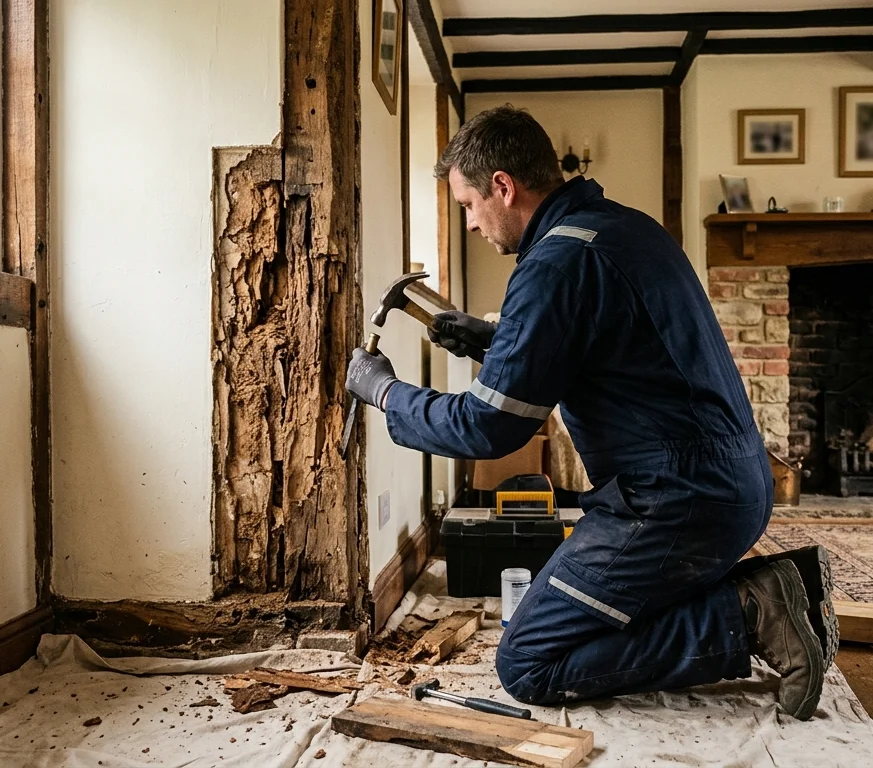
- Skirting that feels soft, crumbly or unusually fragile
- Floorboards that have become weak or distorted
- A floor that feels springy in a particular area
- Timber with cracking, splitting or unusual surface changes
- A persistent damp or musty smell
- Discolouration around timber near damp walls
- Wood that appears darker or wetter than surrounding areas
- Previous repairs that have deteriorated again
A single sign does not automatically mean that timber has lost its structural strength. However, a combination of visible deterioration and a known or suspected moisture problem deserves closer attention.
When Should Joists and Floor Timbers Be Investigated?
Joists deserve particular attention because they can perform a structural role. If moisture has reached a suspended timber floor, decay may develop where ventilation is poor or where timber is in contact with persistently damp conditions.
A specialist review is particularly sensible when:
- A section of floor feels noticeably weaker than the surrounding area.
- Floorboards are sagging or moving more than expected.
- There is visible dampness around joist ends.
- Timber has become soft when gently assessed.
- There has been a long-standing leak or water ingress nearby.
- Previous damp treatment has not resolved the underlying moisture problem.
Joist ends can be especially vulnerable because they may sit within or close to masonry where moisture conditions are difficult to see from the room above. A visible problem with flooring may therefore be only part of the picture.
How Do Dry Rot and Wet Rot Differ?
Dry rot and wet rot are both forms of fungal timber decay, but they behave differently and should not simply be treated as interchangeable problems.
Wet rot generally requires persistently damp timber and tends to remain closely associated with the source of moisture. It can cause timber to darken, soften, crack or lose strength over time.
Dry rot can be more disruptive because the fungus can spread through suitable materials when conditions allow. It is commonly associated with damp, poorly ventilated areas and can affect timber beyond the location where the problem first became visible.
The appearance of damaged wood alone is not always enough to determine which type of decay is present. The surrounding environment, moisture conditions and extent of deterioration all need to be considered.
For homeowners looking for local dry rot experts east london, the important question is not simply whether timber looks damaged, but what has caused the conditions that allowed the deterioration to develop.
Which Areas of a Property Are Most Vulnerable?
Timber decay can occur in many parts of a building, but certain areas are more likely to encounter persistent moisture.
| Timber area | Potential concern | Why inspection may help |
| Floorboards | Softness, movement or distortion | Can indicate moisture beneath the finished floor |
| Joists | Loss of strength or deterioration | Joists may have an important structural role |
| Skirting boards | Softening, staining or crumbling | Can indicate moisture affecting lower wall areas |
| Door frames | Localised deterioration | May occur where moisture reaches timber around openings |
| Window surrounds | Damp-related decay | Defective seals or external defects can allow water ingress |
| Roof timbers | Moisture-related deterioration | Leaks and poor ventilation can create favourable conditions |
This does not mean every damaged timber component needs extensive treatment. The key is to establish whether the deterioration is superficial or whether moisture has affected timber deeper within the construction.
Why Is the Moisture Source So Important?
Treating damaged timber without dealing with the moisture source can leave the underlying conditions unchanged.
For example, imagine skirting boards becoming soft along an external wall. Replacing the skirting may improve the appearance of the room, but if water is still entering through defective pointing, damaged rainwater goods or another external defect, the replacement timber may eventually suffer the same problem.
The same principle applies to timber around a suspended floor. Poor ventilation, ground moisture or plumbing leaks can all create different conditions. The appropriate response depends on what the inspection establishes.
Before arranging major remedial work, speak to our team if you are unsure whether the timber problem is linked to damp, water ingress or another building defect.
What best describes you?

Homeowner

Tenant

Management/Lettings Agent

Potential Buyer

Other
It just takes 60 Second
And then you can book a free consultation
When Is Specialist Timber Assessment Necessary?
Not every mark on a skirting board requires a specialist inspection. Minor cosmetic damage can often be dealt with as part of normal property maintenance.
Specialist assessment becomes more important when there is evidence of deterioration that could extend beyond the visible surface.
This includes:
- Timber that is soft or easily damaged
- Repeated deterioration after repairs
- Significant floor movement
- Extensive staining or fungal growth
- Persistent dampness around timber
- A history of leaks or water penetration
- Decay close to structural timber
- Signs that appear to be spreading
A specialist can assess the affected area in context and determine whether further investigation is justified. This can help distinguish between a localised repair and a problem requiring more comprehensive attention.
Can Dry Rot Be Repaired Without Replacing Everything?
In many cases, timber decay does not mean that every timber element in the property needs to be removed. The appropriate extent of repair depends on the severity and distribution of the deterioration.
Where dry rot has been identified, the inspection should establish how far the problem has extended and which materials are affected. Repair work may involve removing severely damaged timber, addressing the moisture source and carrying out other remedial measures appropriate to the building.
This is why choosing dry rot repair services east london should not be based on a generic treatment package. The scope should reflect the actual condition of the property.
The same principle applies to wet rot. If the affected timber is localised and the moisture source can be controlled, the necessary work may be considerably more focused.
What Happens During a Timber Decay Review?
A useful inspection should begin with the areas where problems have been noticed, but it should not necessarily stop there.
The assessment may consider:
- Visible timber condition – Looking for signs of softening, cracking, staining or other deterioration.
- Moisture conditions – Identifying whether timber is being exposed to persistent moisture.
- Building defects – Considering leaks, external defects, ventilation and other possible contributors.
- Extent of damage – Establishing whether deterioration appears isolated or more widespread.
- Structural relevance – Giving particular attention to timber that performs a supporting role.
- Remedial options – Explaining what work may be appropriate based on the findings.
The purpose is not simply to put a label on the problem. It is to understand the relationship between moisture, timber condition and the building itself.
For more serious cases, the assessment may indicate that additional investigation is appropriate before repair work is finalised.
A Typical East London Property Scenario
Consider a period terraced property where the owner notices a section of flooring feels slightly springy near an external wall. The skirting in the same area has also become discoloured.
Rather than assuming the flooring itself is the cause, an inspection considers the condition of the timber, moisture levels and nearby building details. The assessment finds that moisture has been affecting the area over a prolonged period, with timber deterioration concentrated around part of the floor construction.
The important point is that the visible flooring was only the symptom. Identifying the moisture conditions and assessing the timber beneath helped establish what needed attention and what could remain in place.
How Can You Choose the Right Repair Approach?
The most useful repair recommendation is one that clearly connects the evidence with the proposed work.
Before approving work, check that you understand:
- What type of timber decay has been identified
- Which timber components are affected
- Whether the moisture source has been identified
- What timber needs repair or replacement
- Whether any building defects need attention
- What preparation and making-good are included
- Whether further inspection is recommended
- How the completed work will be documented
If several quotations are being considered, compare their scopes rather than looking at the final price alone. A lower figure may not represent equivalent work if important investigation, preparation or associated repairs have been excluded.
For homeowners seeking local dry rot experts east london, a clear explanation of the findings and proposed work is an important part of making an informed decision.
What Should You Do If Timber Decay Keeps Returning?
Repeated timber deterioration is a reason to look beyond the damaged material itself.
If replacement skirting, floorboards or other timber components continue to deteriorate, consider whether the underlying moisture conditions have actually been resolved. Persistent damp, poor ventilation, water leaks and external defects can all contribute to recurring problems.
In these situations, simply replacing visible timber may provide only a temporary improvement. An assessment that considers the wider building can help establish whether there is an unresolved source of moisture.
Where wet rot is suspected, local wet rot experts east london can assess the affected timber and surrounding conditions to help determine the appropriate next step.
If timber decay is becoming a recurring concern, contact Anke Damp Proofing for practical guidance and an assessment suited to the condition of your property.
Final thoughts
Timber decay is easier to manage when the visible damage is considered alongside the moisture conditions that caused it. Skirting, floorboards and joists can all show signs of deterioration, but their appearance alone may not reveal how far the problem has progressed.
A careful review can help determine whether the issue is localised, whether structural timber is involved and what remedial work is proportionate. For properties where decay has appeared repeatedly, understanding the moisture source is particularly important.
Anke Damp Proofing takes a practical approach to damp and timber-related problems, helping homeowners understand what is happening before deciding on remedial work. If you are concerned about deteriorating timber, a professional assessment can provide greater clarity and help you plan the next step with confidence.
Related articles

What best describes you?
Homeowner
Tenant
Management/Lettings Agent
Potential Buyer
Other
At a glance
In a home, this can affect anything from skirting boards and flooring to joists supporting parts of the building.
The difficult part is that timber decay is not always obvious in its early stages. A slightly springy floor, damaged skirting or a musty smell may seem relatively minor, but these signs can sometimes point to moisture affecting timber behind finished surfaces. Knowing when to investigate can help prevent a small defect from developing into a more disruptive repair.
If you have noticed unexplained changes to timber around your property, Anke Damp Proofing can help assess the condition and identify whether further investigation is appropriate.
What Are the Early Signs of Timber Decay?
Timber decay can present in different ways depending on the type of decay, the moisture source and how long the timber has been exposed to unsuitable conditions.
Some signs are easy to spot, while others are more subtle:
- Skirting that feels soft, crumbly or unusually fragile
- Floorboards that have become weak or distorted
- A floor that feels springy in a particular area
- Timber with cracking, splitting or unusual surface changes
- A persistent damp or musty smell
- Discolouration around timber near damp walls
- Wood that appears darker or wetter than surrounding areas
- Previous repairs that have deteriorated again
A single sign does not automatically mean that timber has lost its structural strength. However, a combination of visible deterioration and a known or suspected moisture problem deserves closer attention.
When Should Joists and Floor Timbers Be Investigated?
Joists deserve particular attention because they can perform a structural role. If moisture has reached a suspended timber floor, decay may develop where ventilation is poor or where timber is in contact with persistently damp conditions.
A specialist review is particularly sensible when:
- A section of floor feels noticeably weaker than the surrounding area.
- Floorboards are sagging or moving more than expected.
- There is visible dampness around joist ends.
- Timber has become soft when gently assessed.
- There has been a long-standing leak or water ingress nearby.
- Previous damp treatment has not resolved the underlying moisture problem.
Joist ends can be especially vulnerable because they may sit within or close to masonry where moisture conditions are difficult to see from the room above. A visible problem with flooring may therefore be only part of the picture.
How Do Dry Rot and Wet Rot Differ?
Dry rot and wet rot are both forms of fungal timber decay, but they behave differently and should not simply be treated as interchangeable problems.
Wet rot generally requires persistently damp timber and tends to remain closely associated with the source of moisture. It can cause timber to darken, soften, crack or lose strength over time.
Dry rot can be more disruptive because the fungus can spread through suitable materials when conditions allow. It is commonly associated with damp, poorly ventilated areas and can affect timber beyond the location where the problem first became visible.
The appearance of damaged wood alone is not always enough to determine which type of decay is present. The surrounding environment, moisture conditions and extent of deterioration all need to be considered.
For homeowners looking for local dry rot experts east london, the important question is not simply whether timber looks damaged, but what has caused the conditions that allowed the deterioration to develop.
Which Areas of a Property Are Most Vulnerable?
Timber decay can occur in many parts of a building, but certain areas are more likely to encounter persistent moisture.
| Timber area | Potential concern | Why inspection may help |
| Floorboards | Softness, movement or distortion | Can indicate moisture beneath the finished floor |
| Joists | Loss of strength or deterioration | Joists may have an important structural role |
| Skirting boards | Softening, staining or crumbling | Can indicate moisture affecting lower wall areas |
| Door frames | Localised deterioration | May occur where moisture reaches timber around openings |
| Window surrounds | Damp-related decay | Defective seals or external defects can allow water ingress |
| Roof timbers | Moisture-related deterioration | Leaks and poor ventilation can create favourable conditions |
This does not mean every damaged timber component needs extensive treatment. The key is to establish whether the deterioration is superficial or whether moisture has affected timber deeper within the construction.
Why Is the Moisture Source So Important?
Treating damaged timber without dealing with the moisture source can leave the underlying conditions unchanged.
For example, imagine skirting boards becoming soft along an external wall. Replacing the skirting may improve the appearance of the room, but if water is still entering through defective pointing, damaged rainwater goods or another external defect, the replacement timber may eventually suffer the same problem.
The same principle applies to timber around a suspended floor. Poor ventilation, ground moisture or plumbing leaks can all create different conditions. The appropriate response depends on what the inspection establishes.
Before arranging major remedial work, speak to our team if you are unsure whether the timber problem is linked to damp, water ingress or another building defect.
What best describes you?
Homeowner
Tenant
Management/Lettings Agent
Potential Buyer
Other
It just takes 60 Second
And then you can book a free consultation
When Is Specialist Timber Assessment Necessary?
Not every mark on a skirting board requires a specialist inspection. Minor cosmetic damage can often be dealt with as part of normal property maintenance.
Specialist assessment becomes more important when there is evidence of deterioration that could extend beyond the visible surface.
This includes:
- Timber that is soft or easily damaged
- Repeated deterioration after repairs
- Significant floor movement
- Extensive staining or fungal growth
- Persistent dampness around timber
- A history of leaks or water penetration
- Decay close to structural timber
- Signs that appear to be spreading
A specialist can assess the affected area in context and determine whether further investigation is justified. This can help distinguish between a localised repair and a problem requiring more comprehensive attention.
Can Dry Rot Be Repaired Without Replacing Everything?
In many cases, timber decay does not mean that every timber element in the property needs to be removed. The appropriate extent of repair depends on the severity and distribution of the deterioration.
Where dry rot has been identified, the inspection should establish how far the problem has extended and which materials are affected. Repair work may involve removing severely damaged timber, addressing the moisture source and carrying out other remedial measures appropriate to the building.
This is why choosing dry rot repair services east london should not be based on a generic treatment package. The scope should reflect the actual condition of the property.
The same principle applies to wet rot. If the affected timber is localised and the moisture source can be controlled, the necessary work may be considerably more focused.
What Happens During a Timber Decay Review?
A useful inspection should begin with the areas where problems have been noticed, but it should not necessarily stop there.
The assessment may consider:
- Visible timber condition – Looking for signs of softening, cracking, staining or other deterioration.
- Moisture conditions – Identifying whether timber is being exposed to persistent moisture.
- Building defects – Considering leaks, external defects, ventilation and other possible contributors.
- Extent of damage – Establishing whether deterioration appears isolated or more widespread.
- Structural relevance – Giving particular attention to timber that performs a supporting role.
- Remedial options – Explaining what work may be appropriate based on the findings.
The purpose is not simply to put a label on the problem. It is to understand the relationship between moisture, timber condition and the building itself.
For more serious cases, the assessment may indicate that additional investigation is appropriate before repair work is finalised.
A Typical East London Property Scenario
Consider a period terraced property where the owner notices a section of flooring feels slightly springy near an external wall. The skirting in the same area has also become discoloured.
Rather than assuming the flooring itself is the cause, an inspection considers the condition of the timber, moisture levels and nearby building details. The assessment finds that moisture has been affecting the area over a prolonged period, with timber deterioration concentrated around part of the floor construction.
The important point is that the visible flooring was only the symptom. Identifying the moisture conditions and assessing the timber beneath helped establish what needed attention and what could remain in place.
How Can You Choose the Right Repair Approach?
The most useful repair recommendation is one that clearly connects the evidence with the proposed work.
Before approving work, check that you understand:
- What type of timber decay has been identified
- Which timber components are affected
- Whether the moisture source has been identified
- What timber needs repair or replacement
- Whether any building defects need attention
- What preparation and making-good are included
- Whether further inspection is recommended
- How the completed work will be documented
If several quotations are being considered, compare their scopes rather than looking at the final price alone. A lower figure may not represent equivalent work if important investigation, preparation or associated repairs have been excluded.
For homeowners seeking local dry rot experts east london, a clear explanation of the findings and proposed work is an important part of making an informed decision.
What Should You Do If Timber Decay Keeps Returning?
Repeated timber deterioration is a reason to look beyond the damaged material itself.
If replacement skirting, floorboards or other timber components continue to deteriorate, consider whether the underlying moisture conditions have actually been resolved. Persistent damp, poor ventilation, water leaks and external defects can all contribute to recurring problems.
In these situations, simply replacing visible timber may provide only a temporary improvement. An assessment that considers the wider building can help establish whether there is an unresolved source of moisture.
Where wet rot is suspected, local wet rot experts east london can assess the affected timber and surrounding conditions to help determine the appropriate next step.
If timber decay is becoming a recurring concern, contact Anke Damp Proofing for practical guidance and an assessment suited to the condition of your property.
Final thoughts
Timber decay is easier to manage when the visible damage is considered alongside the moisture conditions that caused it. Skirting, floorboards and joists can all show signs of deterioration, but their appearance alone may not reveal how far the problem has progressed.
A careful review can help determine whether the issue is localised, whether structural timber is involved and what remedial work is proportionate. For properties where decay has appeared repeatedly, understanding the moisture source is particularly important.
Anke Damp Proofing takes a practical approach to damp and timber-related problems, helping homeowners understand what is happening before deciding on remedial work. If you are concerned about deteriorating timber, a professional assessment can provide greater clarity and help you plan the next step with confidence.
Related articles
What best describes you?
Homeowner
Tenant
Management/Lettings Agent
Potential Buyer