West London Damp Survey Results: What Do They Mean Before You Approve Treatment?
Receiving a damp survey can be reassuring because it gives you information about a problem that may otherwise be difficult to understand.

Why you can trust our content
At a glance
However, a report can also leave homeowners with questions, particularly when it contains moisture readings, technical observations and recommendations for remedial work.
The important thing is to look beyond individual measurements. A useful survey should bring together the condition of the property, visible symptoms, likely moisture sources and the areas requiring attention. The proposed treatment should then follow logically from those findings.
Before approving any work, take time to understand what the survey actually says and whether the recommended solution addresses the cause rather than simply the visible signs.
[CTA 1] If you have received a survey and are unsure what the findings mean, contact Anke Damp Proofing to discuss the next appropriate step before committing to remedial work.
What Should a Damp Survey Tell You?
A damp survey should help establish where moisture has been identified and investigate the likely reason for it.
Depending on the property, the assessment may consider:
- Internal walls and finishes
- External walls and masonry
- Floors and lower wall areas
- Roofs and rainwater goods
- Windows and doors
- Plumbing and drainage
- Ventilation
- Previous remedial work
- Construction details
- Moisture readings
The report should distinguish between observations and conclusions. For example, identifying elevated moisture in a wall is an observation. Establishing why that moisture is present requires consideration of the building and surrounding evidence.
This distinction matters when deciding whether damp proofing west london properties may need. Treatment should be connected to the cause identified during the assessment.
What best describes you?

Homeowner

Tenant

Management/Lettings Agent

Potential Buyer

Other
It just takes 60 Second
And then you can book a free consultation
How Should You Read Moisture Readings?
Moisture meters can provide useful information, but a reading should not automatically be treated as proof of a particular type of damp.
Readings can be influenced by the material being tested, salts, surface conditions and the location of the measurement. The pattern of readings is often more informative than one isolated figure.
When reviewing your report, ask:
- Where were readings taken?
- Were readings taken at different heights?
- Were different materials assessed?
- Were external conditions considered?
- Do the readings support the wider observations?
- Has another possible moisture source been considered?
A professional assessment should explain what the readings mean within the context of the property.
What Different Damp Patterns Can Indicate?
The location and appearance of damp can provide useful clues, although they do not establish a diagnosis on their own.
Lower wall moisture may lead to consideration of ground-related moisture, plumbing or other issues affecting the lower part of the building.
Patches around windows or ceilings may suggest penetrating water or localised defects, depending on the surrounding construction.
Mould around corners and colder surfaces can be associated with condensation, particularly where ventilation and indoor humidity are contributing factors.
Isolated staining near pipes or bathrooms may warrant investigation for plumbing leaks or failed seals.
A good report should consider these possibilities rather than automatically assigning every damp symptom to one cause.
What Should You Check Before Approving Treatment?
Before agreeing to work, compare the findings with the proposed remedial plan.
| Survey finding | Question to ask |
| Moisture in lower walls | What evidence identifies the source? |
| External staining | Has the outside of the building been checked? |
| Mould growth | Has condensation and ventilation been considered? |
| Damaged plaster | Is the damage a symptom or the main issue? |
| Previous treatment | Why did the earlier work not resolve the problem? |
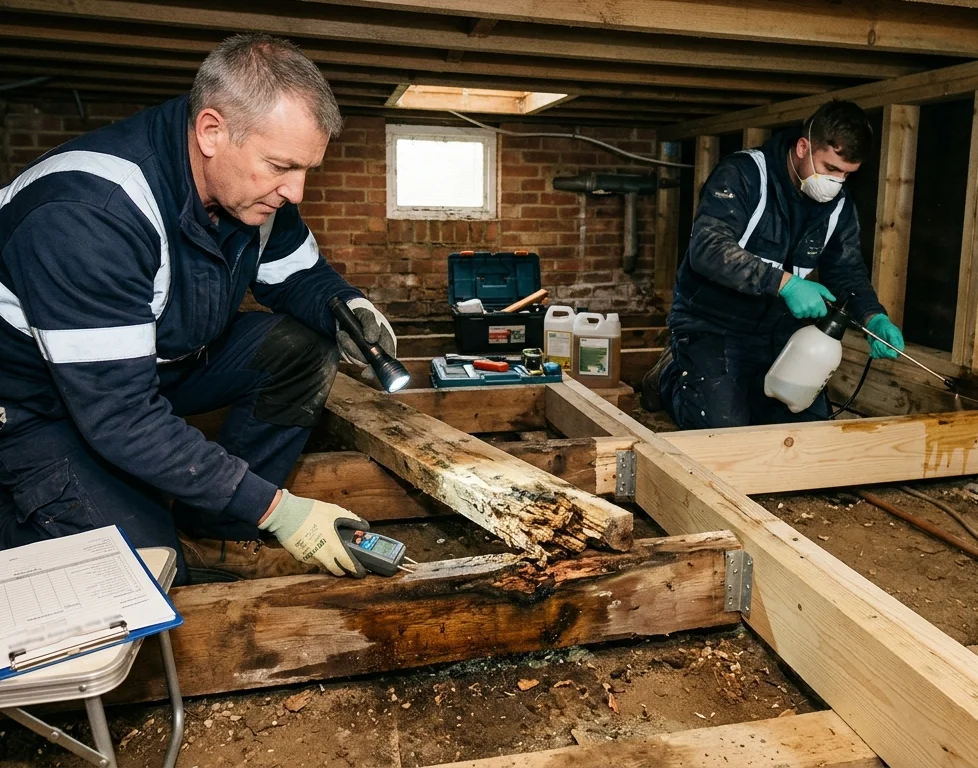
| Timber deterioration | Does the timber require specialist investigation? |
| Water penetration | What external or structural defect is allowing water in? |
| Multiple affected areas | Are there separate causes rather than one problem? |
The proposed treatment should make sense when compared with the evidence. If the report identifies an external defect but the quotation only addresses the internal wall, ask why.
This does not necessarily mean the quotation is wrong. There may be a valid reason for the recommended approach, but that reason should be explained.
Can a Damp Survey Identify More Than One Problem?
Yes. Properties can have several moisture-related issues at the same time.
For example, a period house may have condensation caused by limited ventilation alongside localised penetrating damp from a defective gutter. Treating only one issue would not necessarily remove all of the visible symptoms.
Previous alterations can also complicate matters. Changes to ventilation, extensions, replacement windows or internal finishes may have affected how moisture behaves within the building.
This is why a survey that considers the property as a whole can be more useful than an assessment focused solely on the most obvious damp patch.
If your survey identifies several possible causes or you have received different recommendations, speak to our team before deciding which work to approve.
How Do You Know Whether the Recommended Treatment Is Proportionate?
A good remedial recommendation should be proportionate to the evidence.
If a small, localised defect is identified, the appropriate response may be relatively focused. If moisture is widespread or structural elements are affected, more extensive work may be justified.
When reviewing a recommendation, consider:
- How extensive is the affected area?
- What is causing the moisture?
- Is the proposed treatment addressing that cause?
- Are associated repairs included?
- Is the treatment limited to affected areas?
- Are additional investigations required?
- What happens after the remedial work?
The goal is not necessarily to choose the smallest possible treatment. It is to choose a solution that is appropriate for the actual condition of the building.
What If the Survey Recommends a Damp Proof Course?
A damp proof course may be appropriate in certain circumstances, but the recommendation should be supported by evidence.
Before accepting the proposal, ask why the surveyor believes the problem relates to rising moisture and what alternative causes have been considered.
The construction of the property is also relevant. Older buildings can have solid walls, suspended timber floors and historic alterations that affect how moisture moves through the structure.
A recommendation should therefore be based on the building in front of the surveyor, rather than a generic assumption about the age or appearance of the property.
How Should You Compare Two Damp Treatment Quotations?
If you have more than one quotation, do not compare only the final figures.
Instead, check whether each proposal covers the same:
- Rooms and walls
- Preparation
- Removal of damaged finishes
- Treatment system
- Associated repairs
- Making good
- Materials
- Labour
- Guarantees
- Aftercare
A lower quote may exclude important preparation or finishing work. A higher quote may include a broader scope. Without comparing the details, it is difficult to know whether the figures are genuinely like for like.
When assessing damp proofing west london quotations, clarity of scope is therefore just as important as the price itself.
What Should You Do If a Survey Result Is Unclear?
You should be able to ask questions about a survey before approving treatment.
Useful questions include:
- What is the most likely cause of the damp?
- What evidence supports that conclusion?
- What other causes were considered?
- Which areas require treatment?
- Which areas do not require treatment?
- Are external repairs needed?
- Is condensation contributing to the problem?
- Could plumbing or drainage be involved?
- What happens if the moisture does not resolve after treatment?
If the report uses technical terminology that you do not understand, ask for an explanation in plain English. Understanding the reasoning behind a recommendation is part of making an informed decision.
A Typical West London Property Scenario
Imagine a period terraced home where damp staining has appeared along the lower section of a front room wall. The homeowner receives a survey recommending remedial treatment.
The report records elevated moisture but also notes defects to the external masonry. A second review considers the location of the staining, the condition of the external wall and nearby rainwater arrangements.
The findings suggest that external water penetration may be contributing to the problem. Rather than treating the internal finish alone, the proposed approach considers the external defect and the condition of the affected internal area.
The homeowner now has a clearer basis for deciding what work is necessary because the recommendation relates to the evidence.
When Is a Second Opinion Worth Considering?
A second opinion can be sensible where recommendations vary significantly, the proposed work is extensive or the original findings are difficult to understand.
It can also be useful where previous treatment has failed. If damp has returned, repeating an earlier treatment without investigating the reason for failure may not address the underlying issue.
For a damp survey west london homeowners can use to make a decision, the most valuable outcome is not simply a list of defects. It is a clear understanding of the likely cause, the evidence supporting it and the work that is proportionate to the problem.
What Should a Good Damp Treatment Recommendation Include?
A clear recommendation should tell you:
- What has been found
- What is believed to be causing it
- Which areas are affected
- What treatment is proposed
- Why that treatment is suitable
- What preparation is needed
- Whether other repairs are required
- What is included in the quotation
- What is excluded
- What aftercare or documentation is provided
This information allows you to make a decision without relying solely on the contractor’s final price.
For homeowners comparing local damp proofing experts west london, transparency at this stage can provide useful reassurance.
If you want to understand what your damp survey findings mean before approving treatment, contact Anke Damp Proofing for practical, property-specific guidance.
Final thoughts
A damp survey is most useful when it helps you understand the story behind the symptoms. Moisture readings, visible staining and damaged finishes are important observations, but they need to be interpreted alongside the construction and condition of the building.
Before approving treatment, make sure the proposed work follows logically from the survey findings. Check the cause, scope, preparation, associated repairs and exclusions, and ask questions where the recommendation is unclear.
Anke Damp Proofing can provide practical guidance for homeowners who want to understand their damp problems before deciding on remedial work. Taking time to understand the evidence can help you choose a proportionate solution with greater confidence.
Related articles

What best describes you?
Homeowner
Tenant
Management/Lettings Agent
Potential Buyer
Other
At a glance
However, a report can also leave homeowners with questions, particularly when it contains moisture readings, technical observations and recommendations for remedial work.
The important thing is to look beyond individual measurements. A useful survey should bring together the condition of the property, visible symptoms, likely moisture sources and the areas requiring attention. The proposed treatment should then follow logically from those findings.
Before approving any work, take time to understand what the survey actually says and whether the recommended solution addresses the cause rather than simply the visible signs.
[CTA 1] If you have received a survey and are unsure what the findings mean, contact Anke Damp Proofing to discuss the next appropriate step before committing to remedial work.
What Should a Damp Survey Tell You?
A damp survey should help establish where moisture has been identified and investigate the likely reason for it.
Depending on the property, the assessment may consider:
- Internal walls and finishes
- External walls and masonry
- Floors and lower wall areas
- Roofs and rainwater goods
- Windows and doors
- Plumbing and drainage
- Ventilation
- Previous remedial work
- Construction details
- Moisture readings
The report should distinguish between observations and conclusions. For example, identifying elevated moisture in a wall is an observation. Establishing why that moisture is present requires consideration of the building and surrounding evidence.
This distinction matters when deciding whether damp proofing west london properties may need. Treatment should be connected to the cause identified during the assessment.
What best describes you?
Homeowner
Tenant
Management/Lettings Agent
Potential Buyer
Other
It just takes 60 Second
And then you can book a free consultation
How Should You Read Moisture Readings?
Moisture meters can provide useful information, but a reading should not automatically be treated as proof of a particular type of damp.
Readings can be influenced by the material being tested, salts, surface conditions and the location of the measurement. The pattern of readings is often more informative than one isolated figure.
When reviewing your report, ask:
- Where were readings taken?
- Were readings taken at different heights?
- Were different materials assessed?
- Were external conditions considered?
- Do the readings support the wider observations?
- Has another possible moisture source been considered?
A professional assessment should explain what the readings mean within the context of the property.
What Different Damp Patterns Can Indicate?
The location and appearance of damp can provide useful clues, although they do not establish a diagnosis on their own.
Lower wall moisture may lead to consideration of ground-related moisture, plumbing or other issues affecting the lower part of the building.
Patches around windows or ceilings may suggest penetrating water or localised defects, depending on the surrounding construction.
Mould around corners and colder surfaces can be associated with condensation, particularly where ventilation and indoor humidity are contributing factors.
Isolated staining near pipes or bathrooms may warrant investigation for plumbing leaks or failed seals.
A good report should consider these possibilities rather than automatically assigning every damp symptom to one cause.
What Should You Check Before Approving Treatment?
Before agreeing to work, compare the findings with the proposed remedial plan.
| Survey finding | Question to ask |
| Moisture in lower walls | What evidence identifies the source? |
| External staining | Has the outside of the building been checked? |
| Mould growth | Has condensation and ventilation been considered? |
| Damaged plaster | Is the damage a symptom or the main issue? |
| Previous treatment | Why did the earlier work not resolve the problem? |
| Timber deterioration | Does the timber require specialist investigation? |
| Water penetration | What external or structural defect is allowing water in? |
| Multiple affected areas | Are there separate causes rather than one problem? |
The proposed treatment should make sense when compared with the evidence. If the report identifies an external defect but the quotation only addresses the internal wall, ask why.
This does not necessarily mean the quotation is wrong. There may be a valid reason for the recommended approach, but that reason should be explained.
Can a Damp Survey Identify More Than One Problem?
Yes. Properties can have several moisture-related issues at the same time.
For example, a period house may have condensation caused by limited ventilation alongside localised penetrating damp from a defective gutter. Treating only one issue would not necessarily remove all of the visible symptoms.
Previous alterations can also complicate matters. Changes to ventilation, extensions, replacement windows or internal finishes may have affected how moisture behaves within the building.
This is why a survey that considers the property as a whole can be more useful than an assessment focused solely on the most obvious damp patch.
If your survey identifies several possible causes or you have received different recommendations, speak to our team before deciding which work to approve.
How Do You Know Whether the Recommended Treatment Is Proportionate?
A good remedial recommendation should be proportionate to the evidence.
If a small, localised defect is identified, the appropriate response may be relatively focused. If moisture is widespread or structural elements are affected, more extensive work may be justified.
When reviewing a recommendation, consider:
- How extensive is the affected area?
- What is causing the moisture?
- Is the proposed treatment addressing that cause?
- Are associated repairs included?
- Is the treatment limited to affected areas?
- Are additional investigations required?
- What happens after the remedial work?
The goal is not necessarily to choose the smallest possible treatment. It is to choose a solution that is appropriate for the actual condition of the building.
What If the Survey Recommends a Damp Proof Course?
A damp proof course may be appropriate in certain circumstances, but the recommendation should be supported by evidence.
Before accepting the proposal, ask why the surveyor believes the problem relates to rising moisture and what alternative causes have been considered.
The construction of the property is also relevant. Older buildings can have solid walls, suspended timber floors and historic alterations that affect how moisture moves through the structure.
A recommendation should therefore be based on the building in front of the surveyor, rather than a generic assumption about the age or appearance of the property.
How Should You Compare Two Damp Treatment Quotations?
If you have more than one quotation, do not compare only the final figures.
Instead, check whether each proposal covers the same:
- Rooms and walls
- Preparation
- Removal of damaged finishes
- Treatment system
- Associated repairs
- Making good
- Materials
- Labour
- Guarantees
- Aftercare
A lower quote may exclude important preparation or finishing work. A higher quote may include a broader scope. Without comparing the details, it is difficult to know whether the figures are genuinely like for like.
When assessing damp proofing west london quotations, clarity of scope is therefore just as important as the price itself.
What Should You Do If a Survey Result Is Unclear?
You should be able to ask questions about a survey before approving treatment.
Useful questions include:
- What is the most likely cause of the damp?
- What evidence supports that conclusion?
- What other causes were considered?
- Which areas require treatment?
- Which areas do not require treatment?
- Are external repairs needed?
- Is condensation contributing to the problem?
- Could plumbing or drainage be involved?
- What happens if the moisture does not resolve after treatment?
If the report uses technical terminology that you do not understand, ask for an explanation in plain English. Understanding the reasoning behind a recommendation is part of making an informed decision.
A Typical West London Property Scenario
Imagine a period terraced home where damp staining has appeared along the lower section of a front room wall. The homeowner receives a survey recommending remedial treatment.
The report records elevated moisture but also notes defects to the external masonry. A second review considers the location of the staining, the condition of the external wall and nearby rainwater arrangements.
The findings suggest that external water penetration may be contributing to the problem. Rather than treating the internal finish alone, the proposed approach considers the external defect and the condition of the affected internal area.
The homeowner now has a clearer basis for deciding what work is necessary because the recommendation relates to the evidence.
When Is a Second Opinion Worth Considering?
A second opinion can be sensible where recommendations vary significantly, the proposed work is extensive or the original findings are difficult to understand.
It can also be useful where previous treatment has failed. If damp has returned, repeating an earlier treatment without investigating the reason for failure may not address the underlying issue.
For a damp survey west london homeowners can use to make a decision, the most valuable outcome is not simply a list of defects. It is a clear understanding of the likely cause, the evidence supporting it and the work that is proportionate to the problem.
What Should a Good Damp Treatment Recommendation Include?
A clear recommendation should tell you:
- What has been found
- What is believed to be causing it
- Which areas are affected
- What treatment is proposed
- Why that treatment is suitable
- What preparation is needed
- Whether other repairs are required
- What is included in the quotation
- What is excluded
- What aftercare or documentation is provided
This information allows you to make a decision without relying solely on the contractor’s final price.
For homeowners comparing local damp proofing experts west london, transparency at this stage can provide useful reassurance.
If you want to understand what your damp survey findings mean before approving treatment, contact Anke Damp Proofing for practical, property-specific guidance.
Final thoughts
A damp survey is most useful when it helps you understand the story behind the symptoms. Moisture readings, visible staining and damaged finishes are important observations, but they need to be interpreted alongside the construction and condition of the building.
Before approving treatment, make sure the proposed work follows logically from the survey findings. Check the cause, scope, preparation, associated repairs and exclusions, and ask questions where the recommendation is unclear.
Anke Damp Proofing can provide practical guidance for homeowners who want to understand their damp problems before deciding on remedial work. Taking time to understand the evidence can help you choose a proportionate solution with greater confidence.
Related articles
What best describes you?
Homeowner
Tenant
Management/Lettings Agent
Potential Buyer