
Hertfordshire Timber Decay: Why Does Local Rot Expertise Matter in Older Homes?
Older homes often have timber features that have performed their role for generations. Floorboards, joists, skirting, roof timbers and other wooden components can remain perfectly serviceable for many years, provided the surrounding conditions are suitable.

Why you can trust our content
At a glance
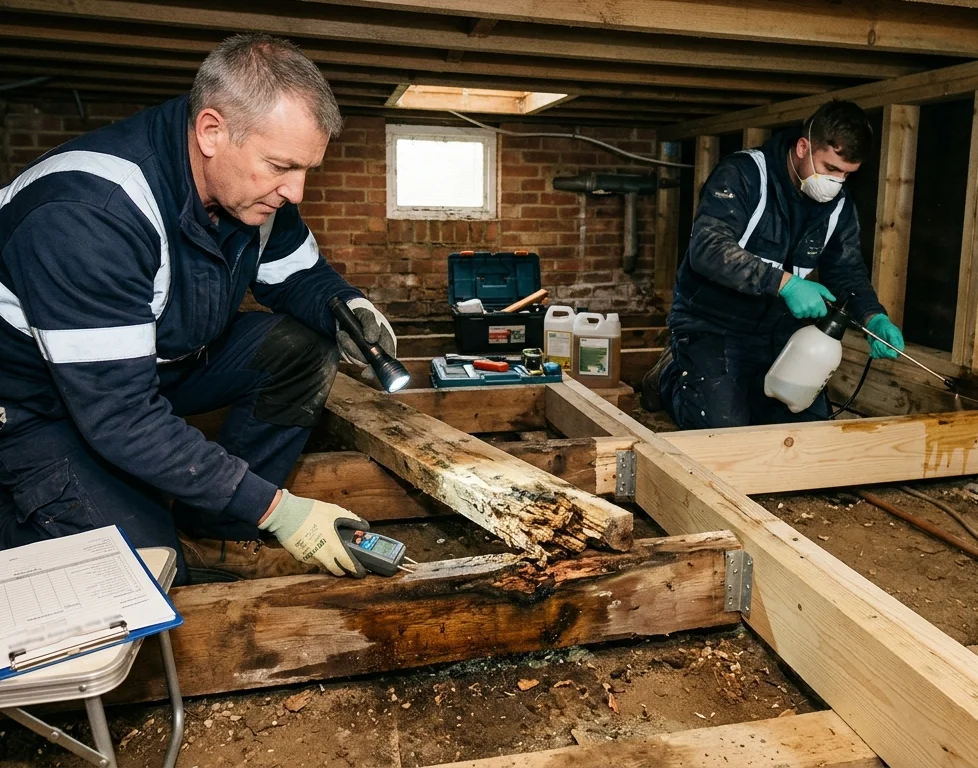
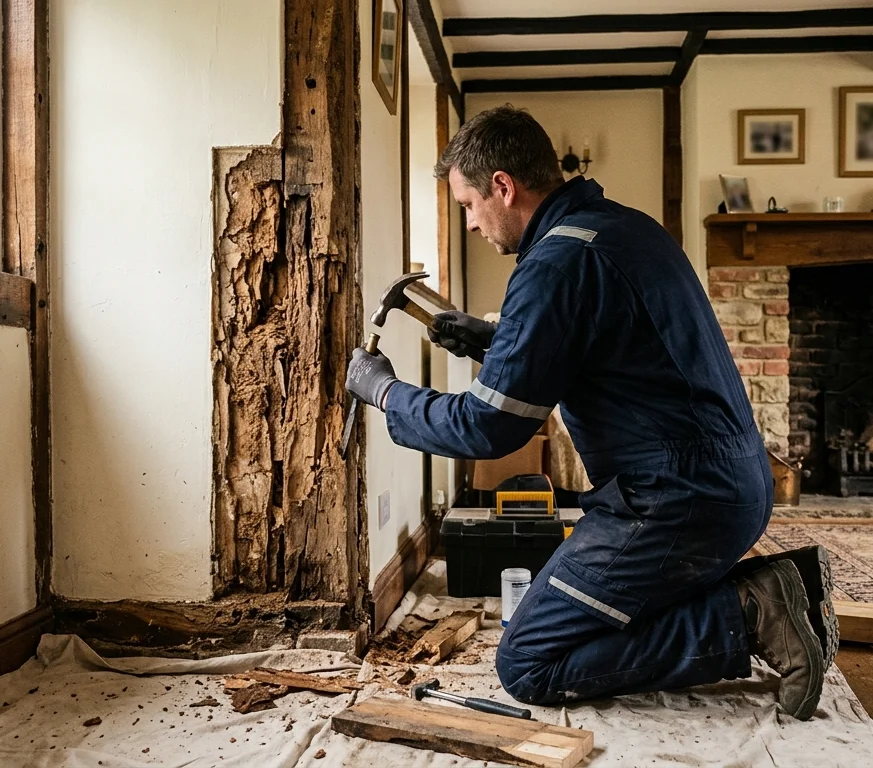
Problems can arise when persistent moisture reaches the timber. Leaks, defective external details, poor ventilation and other building issues can create conditions where fungal decay develops. The visible damage may be limited to one area, while the underlying moisture problem can be less obvious.
Understanding why timber has deteriorated is therefore just as important as repairing the damaged wood. For older properties, familiarity with traditional construction and the way different parts of a building interact can be particularly useful when assessing the extent of a problem.
If you have noticed deteriorating timber in an older property, contact Anke Damp Proofing for practical guidance on whether a specialist assessment is appropriate.
Why Are Older Homes More Vulnerable to Timber Decay?
Age alone does not cause timber decay. The main concern is the condition of the building and whether timber has been exposed to persistent moisture.
Older properties may have characteristics that require careful consideration, including:
- Solid masonry walls
- Suspended timber floors
- Older roof structures
- Timber embedded within or close to masonry
- Historic alterations
- Traditional ventilation arrangements
- Previous damp treatments
- Changes made during renovations
A repair carried out without understanding these features can potentially miss an important moisture source.
This is why homeowners looking for local dry rot experts hertfordshire should consider whether the contractor has experience assessing timber within different types of older construction, rather than simply looking at the damaged wood in isolation.
What Are the Signs of Timber Decay?
Timber decay can appear in several forms, and early signs are not always dramatic.
Homeowners may notice:
- Soft or crumbly wood
- Darkened timber
- Cracking or splitting
- Distorted floorboards
- A springy section of flooring
- Damaged skirting
- Musty smells
- Discolouration around timber
- Repeated deterioration following repairs
- Visible fungal growth
These signs do not automatically establish the type or severity of decay. For example, a damaged skirting board could have been affected by localised moisture without indicating widespread structural deterioration.
The location of the timber and the conditions surrounding it should therefore be considered before deciding what work is necessary.
How Do Dry Rot and Wet Rot Differ?
Dry rot and wet rot are both forms of fungal timber decay, but they are not identical.
Wet rot is generally associated with timber remaining damp for an extended period. The affected wood can become soft, weakened, cracked or discoloured. The deterioration is usually closely linked to the source of moisture.
Dry rot also requires damp conditions to become established, but it can spread through suitable materials and may affect timber beyond the location where the moisture problem first became noticeable.
Identifying the difference matters because the appropriate repair approach depends on the type of decay, its extent and the conditions that have allowed it to develop.
For homeowners seeking local dry rot experts hertfordshire, the priority should be a proper assessment rather than assuming that every damaged timber component requires the same treatment.
Which Parts of an Older Property Need Particular Attention?
Some timber components deserve closer attention because of their location or structural function.
| Timber location | What to look for | Why it matters |
| Floorboards | Softness, movement or distortion | May indicate deterioration beneath the finished floor |
| Joists | Dampness, cracking or weakening | Can perform an important structural role |
| Skirting | Soft or crumbling sections | May indicate moisture near lower walls |
| Roof timbers | Discolouration or decay | Leaks and poor ventilation can affect the roof structure |
| Window surrounds | Localised deterioration | Water may enter through defective external details |
| Door frames | Softness or staining | Can indicate persistent moisture around openings |
The condition of the timber should be considered alongside the source of moisture. A damaged component may be replaceable, but if the surrounding conditions remain damp, the same problem could return.
Why Does Finding the Moisture Source Matter?
Timber does not normally deteriorate without a reason. Persistent moisture is often an important part of the picture.
Potential sources include:
- Leaking plumbing
- Defective gutters
- Damaged downpipes
- Roof leaks
- Cracked render
- Defective pointing
- Water penetration through masonry
- Ground-related moisture
- Poor ventilation
- Condensation
A sensible assessment therefore looks beyond the visible timber.
For example, replacing rotten skirting without addressing water entering through an external wall may improve the room temporarily but leave the conditions that caused the deterioration unchanged.
This is particularly important in older homes, where several building defects can sometimes interact.
If timber damage has appeared alongside damp or recurring moisture, speak to the Anke Damp Proofing team before arranging replacement work so the wider problem can be considered.
What best describes you?

Homeowner
Tenant

Management/Lettings Agent

Potential Buyer

Other
It just takes 60 Second
And then you can book a free consultation
Can Local Knowledge Help With Older Property Assessments?
Local knowledge can be useful because properties within the same broad area may share certain construction characteristics, while individual buildings can still vary considerably.
A contractor familiar with older homes should be comfortable considering how masonry, timber floors, ventilation and previous alterations may influence moisture movement.
However, local experience should complement a proper inspection rather than replace it. A property’s actual condition remains the most important source of evidence.
When considering dry rot repair services hertfordshire, homeowners should therefore ask how the contractor will establish the extent of decay and whether the proposed work is based on the specific building.
Does Timber Decay Always Mean Structural Problems?
No. Timber decay can range from relatively minor deterioration to serious weakening of structural components.
Damaged skirting, for example, may be largely decorative. A deteriorated joist is a different matter because it can contribute to supporting the floor.
This distinction is why the location of the affected timber is important.
A useful assessment should identify:
- Which timber is affected.
- How extensive the deterioration appears to be.
- Whether the timber performs a structural function.
- What moisture conditions are present.
- Whether the affected area is accessible for further inspection.
- What repair or replacement may be appropriate.
The aim is to avoid both extremes: ignoring a potentially significant problem and assuming that every damaged timber component requires extensive replacement.
What Should a Timber Decay Survey Include?
A clear assessment should give homeowners enough information to understand what has been found.
It may include observations about:
- The condition of visible timber
- Moisture levels and likely moisture sources
- Areas where timber is concealed
- External defects
- Internal environmental conditions
- Previous repairs
- The apparent extent of fungal decay
- Structural timber
- Recommended remedial work
If the affected area cannot be fully assessed without removing flooring, plaster or another finish, that limitation should be made clear.
This is particularly valuable when comparing quotations. A homeowner can then understand which conclusions are confirmed and which may depend on further investigation.
How Should You Compare Timber Repair Recommendations?
A repair proposal should be assessed on more than price.
Before approving work, check:
- Has the type of decay been identified?
- Is the moisture source discussed?
- Are the affected areas clearly defined?
- Does the proposal explain what timber will be repaired or replaced?
- Are associated building repairs identified?
- Is preparation included?
- Is making good included?
- Are there exclusions?
- Is further investigation required?
- Are guarantees or supporting documents explained?
Different contractors may recommend different scopes because they have interpreted the condition of the building differently.
When comparing dry rot repair services hertfordshire, ask each contractor to explain the reasoning behind the proposed work. This makes it easier to determine whether the quotations are genuinely comparable.
A Typical Older Property Scenario
Consider an older semi-detached home where the owner notices a soft section of skirting in a downstairs room. There is also a slight musty smell and some staining close to an external wall.
The homeowner initially assumes that the skirting simply needs replacing. During an inspection, however, the condition of the nearby masonry and timber is considered alongside moisture levels and external details.
The assessment identifies a localised source of water penetration and deterioration affecting part of the timber. Some of the visible damage can be dealt with, but the moisture source also needs attention.
The homeowner now has a more complete picture of the problem. Instead of replacing timber and hoping the issue disappears, the repair plan considers both the affected material and the reason it deteriorated.
When Should You Get Specialist Advice?
Professional assessment is particularly worthwhile when timber deterioration is:
- Recurring
- Getting worse
- Affecting joists or other structural timber
- Associated with persistent damp
- Accompanied by unusual floor movement
- Present in several areas
- Difficult to access or assess
- Appearing after previous remedial work
Early investigation does not necessarily mean extensive work will be required. In some cases, it can provide reassurance that the problem is limited.
For homeowners searching for local dry rot experts hertfordshire, the most useful outcome is a clear understanding of the condition of the timber and the steps that may be appropriate.
What Should You Do Before Approving Timber Repairs?
Before agreeing to work, make sure you understand the proposed scope.
Ask:
- What type of decay has been identified?
- What is causing the moisture?
- Which timber is affected?
- Is structural timber involved?
- What needs to be removed?
- What can remain?
- Does the repair address the moisture source?
- What preparation is required?
- What is included in the final price?
- What happens if additional deterioration is discovered?
It can also be helpful to keep records of previous damp or timber treatment, particularly if the property has undergone several renovations.
A clear history can help a contractor understand what has already been attempted and whether the current problem may be connected to an earlier defect.
If you are concerned about timber decay in an older property, contact Anke Damp Proofing to discuss your findings and arrange appropriate professional guidance.
Final thoughts
Timber decay is not simply a matter of replacing damaged wood. The condition of the surrounding building, the source of moisture and the role of the affected timber all need to be considered before a repair plan is agreed.
This is especially relevant in older homes, where traditional construction and previous alterations can influence how moisture moves through the property. A careful assessment can help separate cosmetic deterioration from problems that require more detailed investigation.
Anke Damp Proofing provides practical guidance based on the condition of each property, helping homeowners understand timber and damp-related concerns before deciding on remedial work. If you have noticed signs of decay, getting the problem assessed can give you a clearer and more confident route forward.
Related articles

What best describes you?
Homeowner
Tenant
Management/Lettings Agent
Potential Buyer
Other
At a glance
Problems can arise when persistent moisture reaches the timber. Leaks, defective external details, poor ventilation and other building issues can create conditions where fungal decay develops. The visible damage may be limited to one area, while the underlying moisture problem can be less obvious.
Understanding why timber has deteriorated is therefore just as important as repairing the damaged wood. For older properties, familiarity with traditional construction and the way different parts of a building interact can be particularly useful when assessing the extent of a problem.
If you have noticed deteriorating timber in an older property, contact Anke Damp Proofing for practical guidance on whether a specialist assessment is appropriate.
Why Are Older Homes More Vulnerable to Timber Decay?
Age alone does not cause timber decay. The main concern is the condition of the building and whether timber has been exposed to persistent moisture.
Older properties may have characteristics that require careful consideration, including:
- Solid masonry walls
- Suspended timber floors
- Older roof structures
- Timber embedded within or close to masonry
- Historic alterations
- Traditional ventilation arrangements
- Previous damp treatments
- Changes made during renovations
A repair carried out without understanding these features can potentially miss an important moisture source.
This is why homeowners looking for local dry rot experts hertfordshire should consider whether the contractor has experience assessing timber within different types of older construction, rather than simply looking at the damaged wood in isolation.
What Are the Signs of Timber Decay?
Timber decay can appear in several forms, and early signs are not always dramatic.
Homeowners may notice:
- Soft or crumbly wood
- Darkened timber
- Cracking or splitting
- Distorted floorboards
- A springy section of flooring
- Damaged skirting
- Musty smells
- Discolouration around timber
- Repeated deterioration following repairs
- Visible fungal growth
These signs do not automatically establish the type or severity of decay. For example, a damaged skirting board could have been affected by localised moisture without indicating widespread structural deterioration.
The location of the timber and the conditions surrounding it should therefore be considered before deciding what work is necessary.
How Do Dry Rot and Wet Rot Differ?
Dry rot and wet rot are both forms of fungal timber decay, but they are not identical.
Wet rot is generally associated with timber remaining damp for an extended period. The affected wood can become soft, weakened, cracked or discoloured. The deterioration is usually closely linked to the source of moisture.
Dry rot also requires damp conditions to become established, but it can spread through suitable materials and may affect timber beyond the location where the moisture problem first became noticeable.
Identifying the difference matters because the appropriate repair approach depends on the type of decay, its extent and the conditions that have allowed it to develop.
For homeowners seeking local dry rot experts hertfordshire, the priority should be a proper assessment rather than assuming that every damaged timber component requires the same treatment.
Which Parts of an Older Property Need Particular Attention?
Some timber components deserve closer attention because of their location or structural function.
| Timber location | What to look for | Why it matters |
| Floorboards | Softness, movement or distortion | May indicate deterioration beneath the finished floor |
| Joists | Dampness, cracking or weakening | Can perform an important structural role |
| Skirting | Soft or crumbling sections | May indicate moisture near lower walls |
| Roof timbers | Discolouration or decay | Leaks and poor ventilation can affect the roof structure |
| Window surrounds | Localised deterioration | Water may enter through defective external details |
| Door frames | Softness or staining | Can indicate persistent moisture around openings |
The condition of the timber should be considered alongside the source of moisture. A damaged component may be replaceable, but if the surrounding conditions remain damp, the same problem could return.
Why Does Finding the Moisture Source Matter?
Timber does not normally deteriorate without a reason. Persistent moisture is often an important part of the picture.
Potential sources include:
- Leaking plumbing
- Defective gutters
- Damaged downpipes
- Roof leaks
- Cracked render
- Defective pointing
- Water penetration through masonry
- Ground-related moisture
- Poor ventilation
- Condensation
A sensible assessment therefore looks beyond the visible timber.
For example, replacing rotten skirting without addressing water entering through an external wall may improve the room temporarily but leave the conditions that caused the deterioration unchanged.
This is particularly important in older homes, where several building defects can sometimes interact.
If timber damage has appeared alongside damp or recurring moisture, speak to the Anke Damp Proofing team before arranging replacement work so the wider problem can be considered.
What best describes you?
Homeowner
Tenant
Management/Lettings Agent
Potential Buyer
Other
It just takes 60 Second
And then you can book a free consultation
Can Local Knowledge Help With Older Property Assessments?
Local knowledge can be useful because properties within the same broad area may share certain construction characteristics, while individual buildings can still vary considerably.
A contractor familiar with older homes should be comfortable considering how masonry, timber floors, ventilation and previous alterations may influence moisture movement.
However, local experience should complement a proper inspection rather than replace it. A property’s actual condition remains the most important source of evidence.
When considering dry rot repair services hertfordshire, homeowners should therefore ask how the contractor will establish the extent of decay and whether the proposed work is based on the specific building.
Does Timber Decay Always Mean Structural Problems?
No. Timber decay can range from relatively minor deterioration to serious weakening of structural components.
Damaged skirting, for example, may be largely decorative. A deteriorated joist is a different matter because it can contribute to supporting the floor.
This distinction is why the location of the affected timber is important.
A useful assessment should identify:
- Which timber is affected.
- How extensive the deterioration appears to be.
- Whether the timber performs a structural function.
- What moisture conditions are present.
- Whether the affected area is accessible for further inspection.
- What repair or replacement may be appropriate.
The aim is to avoid both extremes: ignoring a potentially significant problem and assuming that every damaged timber component requires extensive replacement.
What Should a Timber Decay Survey Include?
A clear assessment should give homeowners enough information to understand what has been found.
It may include observations about:
- The condition of visible timber
- Moisture levels and likely moisture sources
- Areas where timber is concealed
- External defects
- Internal environmental conditions
- Previous repairs
- The apparent extent of fungal decay
- Structural timber
- Recommended remedial work
If the affected area cannot be fully assessed without removing flooring, plaster or another finish, that limitation should be made clear.
This is particularly valuable when comparing quotations. A homeowner can then understand which conclusions are confirmed and which may depend on further investigation.
How Should You Compare Timber Repair Recommendations?
A repair proposal should be assessed on more than price.
Before approving work, check:
- Has the type of decay been identified?
- Is the moisture source discussed?
- Are the affected areas clearly defined?
- Does the proposal explain what timber will be repaired or replaced?
- Are associated building repairs identified?
- Is preparation included?
- Is making good included?
- Are there exclusions?
- Is further investigation required?
- Are guarantees or supporting documents explained?
Different contractors may recommend different scopes because they have interpreted the condition of the building differently.
When comparing dry rot repair services hertfordshire, ask each contractor to explain the reasoning behind the proposed work. This makes it easier to determine whether the quotations are genuinely comparable.
A Typical Older Property Scenario
Consider an older semi-detached home where the owner notices a soft section of skirting in a downstairs room. There is also a slight musty smell and some staining close to an external wall.
The homeowner initially assumes that the skirting simply needs replacing. During an inspection, however, the condition of the nearby masonry and timber is considered alongside moisture levels and external details.
The assessment identifies a localised source of water penetration and deterioration affecting part of the timber. Some of the visible damage can be dealt with, but the moisture source also needs attention.
The homeowner now has a more complete picture of the problem. Instead of replacing timber and hoping the issue disappears, the repair plan considers both the affected material and the reason it deteriorated.
When Should You Get Specialist Advice?
Professional assessment is particularly worthwhile when timber deterioration is:
- Recurring
- Getting worse
- Affecting joists or other structural timber
- Associated with persistent damp
- Accompanied by unusual floor movement
- Present in several areas
- Difficult to access or assess
- Appearing after previous remedial work
Early investigation does not necessarily mean extensive work will be required. In some cases, it can provide reassurance that the problem is limited.
For homeowners searching for local dry rot experts hertfordshire, the most useful outcome is a clear understanding of the condition of the timber and the steps that may be appropriate.
What Should You Do Before Approving Timber Repairs?
Before agreeing to work, make sure you understand the proposed scope.
Ask:
- What type of decay has been identified?
- What is causing the moisture?
- Which timber is affected?
- Is structural timber involved?
- What needs to be removed?
- What can remain?
- Does the repair address the moisture source?
- What preparation is required?
- What is included in the final price?
- What happens if additional deterioration is discovered?
It can also be helpful to keep records of previous damp or timber treatment, particularly if the property has undergone several renovations.
A clear history can help a contractor understand what has already been attempted and whether the current problem may be connected to an earlier defect.
If you are concerned about timber decay in an older property, contact Anke Damp Proofing to discuss your findings and arrange appropriate professional guidance.
Final thoughts
Timber decay is not simply a matter of replacing damaged wood. The condition of the surrounding building, the source of moisture and the role of the affected timber all need to be considered before a repair plan is agreed.
This is especially relevant in older homes, where traditional construction and previous alterations can influence how moisture moves through the property. A careful assessment can help separate cosmetic deterioration from problems that require more detailed investigation.
Anke Damp Proofing provides practical guidance based on the condition of each property, helping homeowners understand timber and damp-related concerns before deciding on remedial work. If you have noticed signs of decay, getting the problem assessed can give you a clearer and more confident route forward.
Related articles
What best describes you?
Homeowner
Tenant
Management/Lettings Agent
Potential Buyer