

Floorboards, Joists and Cellar Walls in North London: Which Specialist Do You Need?
Older properties across North London often hide problems beneath their finished surfaces. A floor may begin to feel uneven, a cellar wall might develop persistent damp patches, or timber may start showing signs of decay without any obvious warning.

Why you can trust our content
At a glance
While these issues can appear unrelated, they are frequently connected by one common factor – excess moisture.
Understanding what lies behind these warning signs helps homeowners choose the right specialist before the problem becomes more extensive. Some issues involve timber decay, while others relate to water entering the building itself. Knowing the difference can save time, money and unnecessary disruption.
If you’ve noticed signs of damp or timber deterioration, contact Anke Damp Proofing for an expert assessment before planning remedial work.
What causes hidden timber problems?
Timber remains durable for decades when kept dry. However, prolonged exposure to moisture creates conditions where fungal decay can develop.
Common sources of excess moisture include:
- Leaking pipework beneath suspended floors
- Poor subfloor ventilation
- Penetrating damp through external walls
- Defective guttering
- Basement or cellar moisture
- Roof leaks affecting structural timbers
Addressing the moisture source is always the first priority. Repairing damaged timber without resolving the underlying cause often leads to further deterioration.
How can you tell whether timber decay is becoming serious?
Not every damaged floorboard indicates significant structural problems, but there are several warning signs that deserve further investigation.
These include:
- Springy or uneven flooring
- Crumbling timber
- Deep cracks following the wood grain
- A musty smell beneath floor coverings
- Skirting boards becoming soft
- Visible fungal growth
- Doors or floors becoming misaligned
Where several of these symptoms appear together, a professional inspection is recommended.
Experienced specialists providing dry rot treatment north london will assess both the timber and the moisture source before recommending any remedial work.
Do cellar walls always indicate waterproofing problems?
No.
Damp cellar walls can develop for several different reasons. Ground moisture, inadequate drainage, condensation and defects within the building envelope may all contribute to visible dampness.
Rather than assuming waterproofing is immediately required, a detailed investigation should identify:
- How water is entering the structure
- Whether moisture is seasonal or continuous
- The condition of surrounding walls
- Existing ventilation
- Previous repair work
- Signs of structural movement
Each finding helps determine the most appropriate solution.
Which specialist deals with different problems?
Choosing the right professional depends on what is causing the issue rather than where it appears.
| Problem | Appropriate Specialist |
| Timber fungal decay | Damp and timber specialist |
| Suspected dry rot | Specialist experienced in dry rot treatment north london |
| Basement water ingress | Structural waterproofing specialist |
| Penetrating damp | Damp investigation specialist |
| Condensation | Damp and ventilation specialist |
| Multiple moisture issues | Comprehensive damp survey |
Properties with several moisture-related defects often require a coordinated approach rather than separate repairs.
Could one moisture problem be causing another?
Yes.
A leaking external wall can allow moisture to reach floor timbers, while poor cellar ventilation may increase humidity throughout the lower level of the property.
Likewise, blocked air bricks beneath suspended timber floors reduce airflow, allowing moisture levels to rise gradually over time.
Because moisture frequently affects several building elements simultaneously, experienced surveyors assess the property as a complete system rather than focusing on one isolated defect.
Anke Damp Proofing can carry out a detailed inspection to identify the source of moisture and explain which remedial work, if any, is appropriate.
What best describes you?

Homeowner

Tenant

Management/Lettings Agent

Potential Buyer

Other
It just takes 60 Second
And then you can book a free consultation
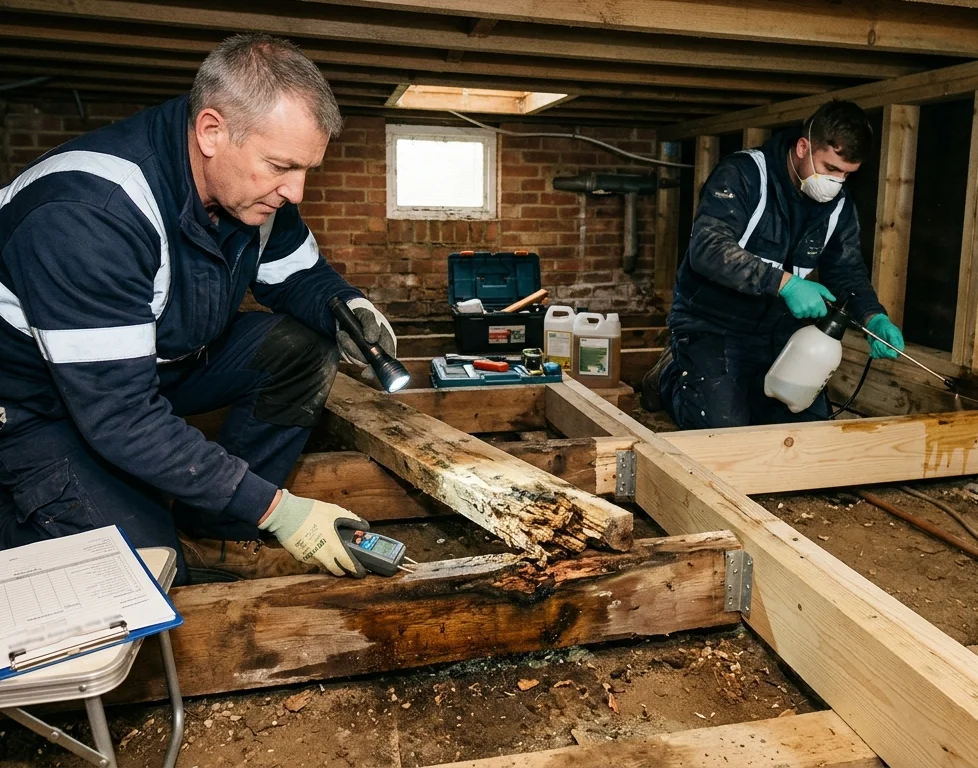
What happens during a professional timber and damp survey?
A thorough inspection looks beyond the obvious signs of decay. The aim is to understand why the timber has deteriorated and whether moisture is still present.
A specialist will typically assess:
- Floorboards and supporting joists
- Moisture levels within timber and masonry
- Subfloor ventilation
- External walls and drainage
- Cellar or basement construction
- Roof or plumbing defects where relevant
- Any visible fungal growth
By examining the whole property, it becomes easier to identify the source of moisture rather than simply repairing the damage it has caused.
A typical North London example
A homeowner notices that the lounge floor has started to creak and dip slightly near an external wall. At the same time, there is a persistent musty smell in the adjacent cellar.
During an inspection, the survey reveals blocked air bricks reducing airflow beneath the suspended timber floor. Moisture has built up over time, creating conditions for fungal decay within several joists. Although the damage appears localised, improving ventilation and repairing the affected timbers prevents the problem from spreading further.
This type of situation demonstrates why identifying the underlying cause is just as important as repairing the visible damage.
When is dry rot more likely to develop?
Dry rot develops when timber remains damp for an extended period. Although the fungus requires moisture to become established, it can continue to spread through adjoining timber if conditions remain favourable.
Homeowners should arrange an inspection if they notice:
- Timber breaking apart easily
- Deep cracking with a cube-like appearance
- Grey or white fungal growth
- Rust-coloured dust or spores
- Strong damp or mushroom-like odours
- Floors that feel unstable
Professional dry rot repair services north london focus not only on replacing damaged timber but also on eliminating the moisture conditions that allowed decay to develop in the first place.
When is waterproofing the right solution?
Not every damp cellar requires waterproofing, but in some cases it provides the most effective long-term protection.
Where water is entering through retaining walls or below ground level, structural waterproofing services north london may be recommended following a detailed assessment.
Suitable waterproofing solutions depend on several factors, including:
- The age and construction of the property
- Groundwater conditions
- Existing drainage systems
- Intended use of the basement or cellar
- The extent of water ingress
Choosing the correct approach requires a clear understanding of how moisture is affecting the structure.
Why is choosing the right specialist so important?
Timber decay and damp often occur together, but they are not always caused by the same issue. Replacing joists without resolving moisture, or waterproofing a cellar without investigating the source of damp, may only provide a temporary improvement.
Experienced professionals take time to understand how the building performs before recommending remedial work. This ensures repairs are appropriate, proportionate and designed to prevent the problem returning.
If decay has already affected structural timbers, dry rot repair services north london should always be carried out alongside measures to control the moisture responsible for the damage.
If you’re concerned about decaying timber, damp cellar walls or moisture beneath your floors, contact Anke Damp Proofing. Our experienced team can assess your property, explain the findings clearly and recommend the most appropriate remedial solution.
Conclusion
Problems beneath floorboards, inside joists and behind cellar walls are rarely isolated. In many cases, they are signs that moisture has been affecting the building for some time. Taking a methodical approach to investigation helps ensure the real cause is identified before repairs begin.
At Anke Damp Proofing, we carefully assess each property to understand how damp and timber decay are connected. Whether you’re dealing with a suspected rot issue, a damp cellar or concerns about structural timber, our experienced team can provide practical advice and recommend the most appropriate solution for your home.
Related articles

What best describes you?
Homeowner
Tenant
Management/Lettings Agent
Potential Buyer
Other
At a glance
While these issues can appear unrelated, they are frequently connected by one common factor – excess moisture.
Understanding what lies behind these warning signs helps homeowners choose the right specialist before the problem becomes more extensive. Some issues involve timber decay, while others relate to water entering the building itself. Knowing the difference can save time, money and unnecessary disruption.
If you’ve noticed signs of damp or timber deterioration, contact Anke Damp Proofing for an expert assessment before planning remedial work.
What causes hidden timber problems?
Timber remains durable for decades when kept dry. However, prolonged exposure to moisture creates conditions where fungal decay can develop.
Common sources of excess moisture include:
- Leaking pipework beneath suspended floors
- Poor subfloor ventilation
- Penetrating damp through external walls
- Defective guttering
- Basement or cellar moisture
- Roof leaks affecting structural timbers
Addressing the moisture source is always the first priority. Repairing damaged timber without resolving the underlying cause often leads to further deterioration.
How can you tell whether timber decay is becoming serious?
Not every damaged floorboard indicates significant structural problems, but there are several warning signs that deserve further investigation.
These include:
- Springy or uneven flooring
- Crumbling timber
- Deep cracks following the wood grain
- A musty smell beneath floor coverings
- Skirting boards becoming soft
- Visible fungal growth
- Doors or floors becoming misaligned
Where several of these symptoms appear together, a professional inspection is recommended.
Experienced specialists providing dry rot treatment north london will assess both the timber and the moisture source before recommending any remedial work.
Do cellar walls always indicate waterproofing problems?
No.
Damp cellar walls can develop for several different reasons. Ground moisture, inadequate drainage, condensation and defects within the building envelope may all contribute to visible dampness.
Rather than assuming waterproofing is immediately required, a detailed investigation should identify:
- How water is entering the structure
- Whether moisture is seasonal or continuous
- The condition of surrounding walls
- Existing ventilation
- Previous repair work
- Signs of structural movement
Each finding helps determine the most appropriate solution.
Which specialist deals with different problems?
Choosing the right professional depends on what is causing the issue rather than where it appears.
| Problem | Appropriate Specialist |
| Timber fungal decay | Damp and timber specialist |
| Suspected dry rot | Specialist experienced in dry rot treatment north london |
| Basement water ingress | Structural waterproofing specialist |
| Penetrating damp | Damp investigation specialist |
| Condensation | Damp and ventilation specialist |
| Multiple moisture issues | Comprehensive damp survey |
Properties with several moisture-related defects often require a coordinated approach rather than separate repairs.
Could one moisture problem be causing another?
Yes.
A leaking external wall can allow moisture to reach floor timbers, while poor cellar ventilation may increase humidity throughout the lower level of the property.
Likewise, blocked air bricks beneath suspended timber floors reduce airflow, allowing moisture levels to rise gradually over time.
Because moisture frequently affects several building elements simultaneously, experienced surveyors assess the property as a complete system rather than focusing on one isolated defect.
Anke Damp Proofing can carry out a detailed inspection to identify the source of moisture and explain which remedial work, if any, is appropriate.
What best describes you?
Homeowner
Tenant
Management/Lettings Agent
Potential Buyer
Other
It just takes 60 Second
And then you can book a free consultation
What happens during a professional timber and damp survey?
A thorough inspection looks beyond the obvious signs of decay. The aim is to understand why the timber has deteriorated and whether moisture is still present.
A specialist will typically assess:
- Floorboards and supporting joists
- Moisture levels within timber and masonry
- Subfloor ventilation
- External walls and drainage
- Cellar or basement construction
- Roof or plumbing defects where relevant
- Any visible fungal growth
By examining the whole property, it becomes easier to identify the source of moisture rather than simply repairing the damage it has caused.
A typical North London example
A homeowner notices that the lounge floor has started to creak and dip slightly near an external wall. At the same time, there is a persistent musty smell in the adjacent cellar.
During an inspection, the survey reveals blocked air bricks reducing airflow beneath the suspended timber floor. Moisture has built up over time, creating conditions for fungal decay within several joists. Although the damage appears localised, improving ventilation and repairing the affected timbers prevents the problem from spreading further.
This type of situation demonstrates why identifying the underlying cause is just as important as repairing the visible damage.
When is dry rot more likely to develop?
Dry rot develops when timber remains damp for an extended period. Although the fungus requires moisture to become established, it can continue to spread through adjoining timber if conditions remain favourable.
Homeowners should arrange an inspection if they notice:
- Timber breaking apart easily
- Deep cracking with a cube-like appearance
- Grey or white fungal growth
- Rust-coloured dust or spores
- Strong damp or mushroom-like odours
- Floors that feel unstable
Professional dry rot repair services north london focus not only on replacing damaged timber but also on eliminating the moisture conditions that allowed decay to develop in the first place.
When is waterproofing the right solution?
Not every damp cellar requires waterproofing, but in some cases it provides the most effective long-term protection.
Where water is entering through retaining walls or below ground level, structural waterproofing services north london may be recommended following a detailed assessment.
Suitable waterproofing solutions depend on several factors, including:
- The age and construction of the property
- Groundwater conditions
- Existing drainage systems
- Intended use of the basement or cellar
- The extent of water ingress
Choosing the correct approach requires a clear understanding of how moisture is affecting the structure.
Why is choosing the right specialist so important?
Timber decay and damp often occur together, but they are not always caused by the same issue. Replacing joists without resolving moisture, or waterproofing a cellar without investigating the source of damp, may only provide a temporary improvement.
Experienced professionals take time to understand how the building performs before recommending remedial work. This ensures repairs are appropriate, proportionate and designed to prevent the problem returning.
If decay has already affected structural timbers, dry rot repair services north london should always be carried out alongside measures to control the moisture responsible for the damage.
If you’re concerned about decaying timber, damp cellar walls or moisture beneath your floors, contact Anke Damp Proofing. Our experienced team can assess your property, explain the findings clearly and recommend the most appropriate remedial solution.
Conclusion
Problems beneath floorboards, inside joists and behind cellar walls are rarely isolated. In many cases, they are signs that moisture has been affecting the building for some time. Taking a methodical approach to investigation helps ensure the real cause is identified before repairs begin.
At Anke Damp Proofing, we carefully assess each property to understand how damp and timber decay are connected. Whether you’re dealing with a suspected rot issue, a damp cellar or concerns about structural timber, our experienced team can provide practical advice and recommend the most appropriate solution for your home.
Related articles
What best describes you?
Homeowner
Tenant
Management/Lettings Agent
Potential Buyer