
West London Dry Rot and Wet Rot: How to Plan Repairs Without Guesswork
Finding damaged timber in a home can raise an immediate question: does it need replacing, or is there a larger problem behind it? Timber decay can affect relatively small decorative elements, but it can also involve floor structures, joists and other important parts of a building.

Why you can trust our content
At a glance
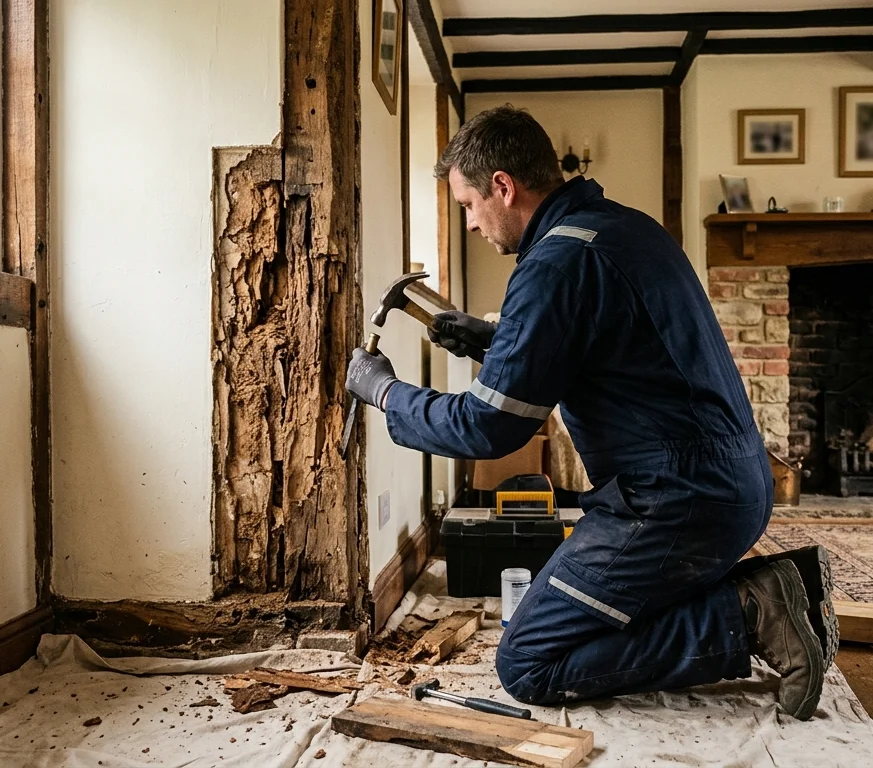
Dry rot and wet rot are two different forms of fungal decay, and neither should be treated simply because timber looks damaged. The surrounding moisture conditions, the location of the decay and the condition of the affected timber all matter when deciding what should happen next.
For homeowners planning repairs, the aim should be to understand the problem before removing or replacing materials. A clear assessment can help distinguish necessary work from repairs that may not address the underlying cause.
If you have discovered deteriorating timber and are unsure how serious it is, contact Anke Damp Proofing for practical advice on the next appropriate step.
What Is the Difference Between Dry Rot and Wet Rot?
Both dry rot and wet rot are forms of fungal timber decay, but they behave differently.
Wet rot is generally associated with timber that remains persistently damp. The affected wood may become discoloured, softened, cracked or weakened. The decay tends to remain relatively close to the source of moisture.
Dry rot also requires favourable damp conditions, but it can be more difficult to contain because the fungus can spread through suitable materials when conditions allow. It may affect timber beyond the point where the original moisture problem is most obvious.
The visible appearance of timber is not always enough to identify the type of decay. A specialist assessment should consider moisture, surrounding materials and the extent of the affected area.
For homeowners looking for local dry rot experts west london, the important consideration is not simply identifying a name for the problem, but understanding what conditions have allowed the decay to develop.
What Signs Suggest Timber Needs Further Investigation?
Some timber deterioration is cosmetic, while other signs may indicate a more significant problem.
Look out for:
- Soft or crumbly timber
- Floorboards that feel unusually weak
- Localised movement in a suspended floor
- Darkened or discoloured wood
- Splitting or cracking
- A persistent musty smell
- Damaged skirting around damp walls
- Visible fungal growth
- Repeated deterioration after previous repairs
- Damp conditions around joists or other structural timber
One symptom does not automatically mean serious decay. However, several signs occurring together warrant closer investigation.
This is particularly important where joists or other supporting timber are involved. Structural relevance should be considered alongside the condition of the wood.
How Can You Plan Timber Repairs Without Guesswork?
The first step is to establish what is actually affected.
A useful assessment should consider:
- The type of decay – Whether the evidence is consistent with dry rot, wet rot or another form of deterioration.
- The moisture source – Identifying where persistent moisture is coming from.
- The extent of the affected timber – Establishing whether damage appears localised or more widespread.
- The condition of surrounding materials – Looking beyond the most obvious visible defect.
- The structural role of the timber – Giving particular attention to joists and supporting components.
- The appropriate repair strategy – Determining what should be repaired, removed, replaced or monitored.
This approach avoids starting with the assumption that everything damaged must be removed.
The correct repair depends on the evidence available from the property.
Why Is Finding the Moisture Source So Important?
Timber decay is strongly linked to moisture. If the conditions that allowed the deterioration to develop remain unchanged, repairing the timber alone may not solve the wider problem.
Potential moisture sources can include:
- Plumbing leaks
- Defective gutters
- Damaged rainwater pipes
- Roof defects
- Poor external pointing
- Water penetration through walls
- Ground-related moisture
- Inadequate ventilation
- Condensation
For example, replacing a section of rotten skirting may restore the appearance of a room, but if rainwater is continuing to enter through a defective external detail, the new timber may eventually deteriorate too.
A good repair plan therefore considers both the damaged material and the building conditions around it.
If you are planning repairs but have not yet established where the moisture is coming from, speak to our team before arranging extensive timber replacement.
What best describes you?

Homeowner
Tenant

Management/Lettings Agent

Potential Buyer

Other
It just takes 60 Second
And then you can book a free consultation
Should All Damaged Timber Be Replaced?
No. The extent of replacement should depend on the condition and role of the affected timber.
Severely deteriorated timber may no longer provide the required strength and could require replacement. In other situations, the affected area may be limited and repair may be possible once the moisture conditions have been addressed.
A quotation should therefore explain what timber has been identified as requiring removal or repair and why.
If extensive replacement is recommended, ask whether the contractor can explain the evidence supporting the proposed scope. This is especially important when the affected area is difficult to see or access.
A clear repair plan gives you a better understanding of what work is necessary before it begins.
What Should a Timber Decay Inspection Cover?
A thorough inspection does not need to be complicated for the homeowner to understand. It should simply provide enough information to explain the condition of the building.
| Inspection area | What should be considered |
| Visible timber | Softness, cracking, staining and deterioration |
| Floor structure | Condition of boards, joists and supporting components |
| Moisture | Current damp conditions and potential sources |
| External areas | Gutters, pointing, render and other possible defects |
| Internal environment | Ventilation and condensation risks |
| Previous repairs | Existing treatments and recurring problems |
| Extent of decay | Whether deterioration appears localised or widespread |
| Repair requirements | What should be repaired, removed or replaced |
The inspection should also make clear where the evidence is limited. Some timber may be hidden behind plaster, flooring or other finishes, making further investigation necessary before the final scope can be confirmed.
How Should You Compare Timber Repair Quotes?
Price alone can be a poor guide when comparing timber decay repairs.
Instead, compare the details of each proposal:
- What type of decay has been identified?
- Which areas are affected?
- Is the moisture source addressed?
- Which timber needs removal?
- What replacement or repair work is proposed?
- Are associated building repairs included?
- Is preparation covered?
- Is making good included?
- Are there exclusions?
- What documentation or guarantee is provided?
Two contractors may provide different prices because they have proposed different scopes. A lower quote is not necessarily better value if important parts of the repair have been excluded.
When considering local dry rot experts west london, look for a clear explanation of how the proposed repair relates to the condition found during inspection.
What Happens If Dry Rot or Wet Rot Is Left Unchecked?
The consequences depend on the location and extent of the decay.
A small area of damaged skirting may remain relatively localised. However, persistent moisture affecting structural timber can lead to progressive deterioration.
Potential concerns include:
- Increasing timber weakness
- Greater repair requirements
- Damage spreading to adjacent materials
- Continued moisture problems
- Disruption to flooring or internal finishes
- More complicated access requirements
This does not mean every suspected case is an emergency. It means that unexplained deterioration should not simply be covered up without understanding why it has occurred.
Early assessment can provide a clearer picture of whether action is required and how extensive that action needs to be.
A Typical West London Property Scenario
Imagine a period terrace where the owner notices soft skirting and a slight change in floor movement near an external wall. The initial assumption is that the skirting simply needs replacing.
An inspection identifies persistent moisture affecting the lower part of the wall and timber nearby. Further checks show that an external defect is contributing to water penetration, while some timber has also deteriorated.
Instead of treating the visible skirting as an isolated problem, the repair plan addresses the moisture source and assesses the affected timber. This gives the homeowner a more useful solution because the work is based on the cause as well as the symptom.
When Is Wet Rot Treatment Appropriate?
Wet rot treatment should be based on the condition of the timber and the source of moisture rather than simply the presence of staining.
Where wet rot has been identified, the key questions are:
- How extensive is the decay?
- How wet is the surrounding timber?
- What is causing the persistent moisture?
- Is the affected timber structural?
- Can the moisture source be controlled?
- What timber needs repair or replacement?
The answer to these questions helps establish the appropriate scope.
For homeowners considering wet rot treatment west london, a property-specific assessment can help avoid both under-treatment and unnecessary replacement.
What Should You Ask Before Repair Work Starts?
Before agreeing to timber decay work, make sure you understand the proposed process.
Ask:
- What type of decay has been identified?
- What caused the timber to become vulnerable?
- Which areas are affected?
- Does the repair include the underlying moisture source?
- What timber will be removed?
- What will be repaired or replaced?
- Will any additional building work be needed?
- What happens to existing finishes?
- What is included in the quotation?
- What happens if further decay is discovered once work begins?
These questions are particularly useful when the affected timber is concealed or when access is limited.
If you would like a clearer assessment of timber decay before approving repairs, contact Anke Damp Proofing to discuss the condition of your property and the appropriate next step.
Final thoughts
Planning timber decay repairs does not have to involve guesswork. The most useful approach is to understand the type of deterioration, identify the moisture conditions that allowed it to develop and establish which timber is genuinely affected.
Whether the issue involves skirting, flooring, joists or concealed timber, the proposed repair should be connected to the evidence found during inspection. This helps avoid unnecessary replacement while ensuring important deterioration is not overlooked.
Anke Damp Proofing can help homeowners understand damp and timber-related problems through practical assessment and clear recommendations. If you have noticed signs of decay, getting the situation reviewed can give you a more confident basis for deciding what happens next.
Related articles

What best describes you?
Homeowner
Tenant
Management/Lettings Agent
Potential Buyer
Other
At a glance
Dry rot and wet rot are two different forms of fungal decay, and neither should be treated simply because timber looks damaged. The surrounding moisture conditions, the location of the decay and the condition of the affected timber all matter when deciding what should happen next.
For homeowners planning repairs, the aim should be to understand the problem before removing or replacing materials. A clear assessment can help distinguish necessary work from repairs that may not address the underlying cause.
If you have discovered deteriorating timber and are unsure how serious it is, contact Anke Damp Proofing for practical advice on the next appropriate step.
What Is the Difference Between Dry Rot and Wet Rot?
Both dry rot and wet rot are forms of fungal timber decay, but they behave differently.
Wet rot is generally associated with timber that remains persistently damp. The affected wood may become discoloured, softened, cracked or weakened. The decay tends to remain relatively close to the source of moisture.
Dry rot also requires favourable damp conditions, but it can be more difficult to contain because the fungus can spread through suitable materials when conditions allow. It may affect timber beyond the point where the original moisture problem is most obvious.
The visible appearance of timber is not always enough to identify the type of decay. A specialist assessment should consider moisture, surrounding materials and the extent of the affected area.
For homeowners looking for local dry rot experts west london, the important consideration is not simply identifying a name for the problem, but understanding what conditions have allowed the decay to develop.
What Signs Suggest Timber Needs Further Investigation?
Some timber deterioration is cosmetic, while other signs may indicate a more significant problem.
Look out for:
- Soft or crumbly timber
- Floorboards that feel unusually weak
- Localised movement in a suspended floor
- Darkened or discoloured wood
- Splitting or cracking
- A persistent musty smell
- Damaged skirting around damp walls
- Visible fungal growth
- Repeated deterioration after previous repairs
- Damp conditions around joists or other structural timber
One symptom does not automatically mean serious decay. However, several signs occurring together warrant closer investigation.
This is particularly important where joists or other supporting timber are involved. Structural relevance should be considered alongside the condition of the wood.
How Can You Plan Timber Repairs Without Guesswork?
The first step is to establish what is actually affected.
A useful assessment should consider:
- The type of decay – Whether the evidence is consistent with dry rot, wet rot or another form of deterioration.
- The moisture source – Identifying where persistent moisture is coming from.
- The extent of the affected timber – Establishing whether damage appears localised or more widespread.
- The condition of surrounding materials – Looking beyond the most obvious visible defect.
- The structural role of the timber – Giving particular attention to joists and supporting components.
- The appropriate repair strategy – Determining what should be repaired, removed, replaced or monitored.
This approach avoids starting with the assumption that everything damaged must be removed.
The correct repair depends on the evidence available from the property.
Why Is Finding the Moisture Source So Important?
Timber decay is strongly linked to moisture. If the conditions that allowed the deterioration to develop remain unchanged, repairing the timber alone may not solve the wider problem.
Potential moisture sources can include:
- Plumbing leaks
- Defective gutters
- Damaged rainwater pipes
- Roof defects
- Poor external pointing
- Water penetration through walls
- Ground-related moisture
- Inadequate ventilation
- Condensation
For example, replacing a section of rotten skirting may restore the appearance of a room, but if rainwater is continuing to enter through a defective external detail, the new timber may eventually deteriorate too.
A good repair plan therefore considers both the damaged material and the building conditions around it.
If you are planning repairs but have not yet established where the moisture is coming from, speak to our team before arranging extensive timber replacement.
What best describes you?
Homeowner
Tenant
Management/Lettings Agent
Potential Buyer
Other
It just takes 60 Second
And then you can book a free consultation
Should All Damaged Timber Be Replaced?
No. The extent of replacement should depend on the condition and role of the affected timber.
Severely deteriorated timber may no longer provide the required strength and could require replacement. In other situations, the affected area may be limited and repair may be possible once the moisture conditions have been addressed.
A quotation should therefore explain what timber has been identified as requiring removal or repair and why.
If extensive replacement is recommended, ask whether the contractor can explain the evidence supporting the proposed scope. This is especially important when the affected area is difficult to see or access.
A clear repair plan gives you a better understanding of what work is necessary before it begins.
What Should a Timber Decay Inspection Cover?
A thorough inspection does not need to be complicated for the homeowner to understand. It should simply provide enough information to explain the condition of the building.
| Inspection area | What should be considered |
| Visible timber | Softness, cracking, staining and deterioration |
| Floor structure | Condition of boards, joists and supporting components |
| Moisture | Current damp conditions and potential sources |
| External areas | Gutters, pointing, render and other possible defects |
| Internal environment | Ventilation and condensation risks |
| Previous repairs | Existing treatments and recurring problems |
| Extent of decay | Whether deterioration appears localised or widespread |
| Repair requirements | What should be repaired, removed or replaced |
The inspection should also make clear where the evidence is limited. Some timber may be hidden behind plaster, flooring or other finishes, making further investigation necessary before the final scope can be confirmed.
How Should You Compare Timber Repair Quotes?
Price alone can be a poor guide when comparing timber decay repairs.
Instead, compare the details of each proposal:
- What type of decay has been identified?
- Which areas are affected?
- Is the moisture source addressed?
- Which timber needs removal?
- What replacement or repair work is proposed?
- Are associated building repairs included?
- Is preparation covered?
- Is making good included?
- Are there exclusions?
- What documentation or guarantee is provided?
Two contractors may provide different prices because they have proposed different scopes. A lower quote is not necessarily better value if important parts of the repair have been excluded.
When considering local dry rot experts west london, look for a clear explanation of how the proposed repair relates to the condition found during inspection.
What Happens If Dry Rot or Wet Rot Is Left Unchecked?
The consequences depend on the location and extent of the decay.
A small area of damaged skirting may remain relatively localised. However, persistent moisture affecting structural timber can lead to progressive deterioration.
Potential concerns include:
- Increasing timber weakness
- Greater repair requirements
- Damage spreading to adjacent materials
- Continued moisture problems
- Disruption to flooring or internal finishes
- More complicated access requirements
This does not mean every suspected case is an emergency. It means that unexplained deterioration should not simply be covered up without understanding why it has occurred.
Early assessment can provide a clearer picture of whether action is required and how extensive that action needs to be.
A Typical West London Property Scenario
Imagine a period terrace where the owner notices soft skirting and a slight change in floor movement near an external wall. The initial assumption is that the skirting simply needs replacing.
An inspection identifies persistent moisture affecting the lower part of the wall and timber nearby. Further checks show that an external defect is contributing to water penetration, while some timber has also deteriorated.
Instead of treating the visible skirting as an isolated problem, the repair plan addresses the moisture source and assesses the affected timber. This gives the homeowner a more useful solution because the work is based on the cause as well as the symptom.
When Is Wet Rot Treatment Appropriate?
Wet rot treatment should be based on the condition of the timber and the source of moisture rather than simply the presence of staining.
Where wet rot has been identified, the key questions are:
- How extensive is the decay?
- How wet is the surrounding timber?
- What is causing the persistent moisture?
- Is the affected timber structural?
- Can the moisture source be controlled?
- What timber needs repair or replacement?
The answer to these questions helps establish the appropriate scope.
For homeowners considering wet rot treatment west london, a property-specific assessment can help avoid both under-treatment and unnecessary replacement.
What Should You Ask Before Repair Work Starts?
Before agreeing to timber decay work, make sure you understand the proposed process.
Ask:
- What type of decay has been identified?
- What caused the timber to become vulnerable?
- Which areas are affected?
- Does the repair include the underlying moisture source?
- What timber will be removed?
- What will be repaired or replaced?
- Will any additional building work be needed?
- What happens to existing finishes?
- What is included in the quotation?
- What happens if further decay is discovered once work begins?
These questions are particularly useful when the affected timber is concealed or when access is limited.
If you would like a clearer assessment of timber decay before approving repairs, contact Anke Damp Proofing to discuss the condition of your property and the appropriate next step.
Final thoughts
Planning timber decay repairs does not have to involve guesswork. The most useful approach is to understand the type of deterioration, identify the moisture conditions that allowed it to develop and establish which timber is genuinely affected.
Whether the issue involves skirting, flooring, joists or concealed timber, the proposed repair should be connected to the evidence found during inspection. This helps avoid unnecessary replacement while ensuring important deterioration is not overlooked.
Anke Damp Proofing can help homeowners understand damp and timber-related problems through practical assessment and clear recommendations. If you have noticed signs of decay, getting the situation reviewed can give you a more confident basis for deciding what happens next.
Related articles
What best describes you?
Homeowner
Tenant
Management/Lettings Agent
Potential Buyer