
Dry or Wet Rot in North London: How to Tell When Timber Is Losing Strength
Timber can deteriorate quietly for months before the signs become obvious. A small patch of damaged skirting may look cosmetic,…

Why you can trust our content

At a glance
Timber can deteriorate quietly for months before the signs become obvious. A small patch of damaged skirting may look cosmetic, while staining around a floorboard can seem like an isolated moisture problem. In reality, decay can sometimes affect the strength of timber beneath the visible surface.
The important point is that dry rot and wet rot are different problems, even though both are associated with damp conditions. Knowing what to look for can help homeowners decide when a closer inspection is sensible and when professional treatment may be required.
If you have noticed unexplained timber damage, changes to floorboards or persistent moisture, contacting Anke Damp Proofing for an assessment can help establish what is actually happening before repair work is planned.
What is the difference between dry rot and wet rot?
Dry rot and wet rot are both forms of fungal timber decay, but they behave differently and require the underlying moisture problem to be understood.
Dry rot can spread beyond the area where moisture first entered the building. It may affect timber that is not directly touching a damp wall, particularly where conditions allow fungal growth to develop and spread.
Wet rot is generally more closely associated with persistently damp timber. It commonly remains concentrated around the source of moisture, although the affected timber can still suffer significant deterioration.
Neither should be diagnosed from appearance alone. A professional assessment considers the condition of the timber, moisture levels, surrounding building materials and likely source of damp.
What signs suggest that timber is losing strength?
The most useful warning signs are changes in the timber itself rather than simply the presence of mould or staining.
Look out for:
- Timber that feels unusually soft when gently assessed
- Crumbling or breaking wood
- Darkened or discoloured areas
- Cracks running through timber
- Floorboards that feel weak, springy or unstable
- Skirting that has become distorted or damaged
- A musty smell around timber
- Visible fungal growth
- Moisture staining close to affected wood
- Damage that appears to be spreading
A particularly important warning sign is timber that no longer feels structurally sound. A damaged skirting board is one thing, but deterioration affecting joists, floor supports or other load-bearing timber deserves more careful investigation.
How can dry rot affect a North London property?
Dry rot is often associated with damp, poorly ventilated or enclosed areas where timber remains at a suitable moisture level for fungal growth. It can be particularly concerning because the visible damage does not always reveal the full extent of the problem.
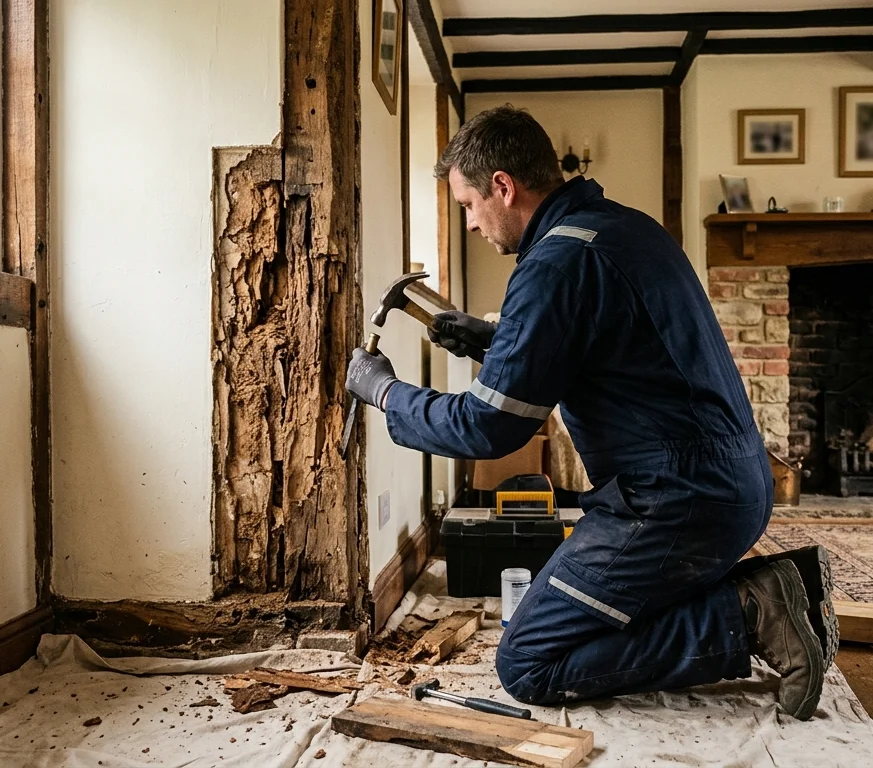
Signs may include brittle timber, cracking, fungal growth or a distinctive musty environment. In more advanced cases, timber can lose much of its original strength.
Finding a small affected area does not automatically mean that a whole property has widespread decay. Equally, covering or replacing the visible timber without identifying the source of moisture may leave the underlying problem unresolved.
This is why homeowners looking for local dry rot experts north london should focus on the quality of the inspection as much as the proposed treatment.
When does wet rot require specialist attention?
Wet rot normally develops where timber has remained exposed to excess moisture for a prolonged period. The source could be related to a leak, defective external detail, poor ventilation, condensation or another moisture-related issue.
The timber may become discoloured, softened or weakened. Unlike some surface-level damp marks, the problem does not necessarily disappear simply because the timber is allowed to dry.
Effective wet rot treatment north london should therefore start with understanding why the timber became damp in the first place. If the moisture source remains, replacing damaged wood alone may not provide a lasting solution.
A survey can help separate visible symptoms from the cause. If you are unsure whether damaged timber needs treatment or simple repair, speak to Anke Damp Proofing for tailored advice before committing to unnecessary work.
Which timber should be checked during an inspection?
Not every piece of damaged wood carries the same significance. The location and function of the timber matter.
| Timber area | What to look for | Why it matters |
| Skirting boards | Softness, staining or crumbling | May indicate persistent moisture near walls or floors |
| Floorboards | Movement, weakness or dark staining | Can suggest moisture affecting the floor structure |
| Joists | Soft spots, cracking or decay | Potentially more significant because joists support floors |
| Door frames | Distortion or localised decay | May indicate moisture around openings |
| Timber beneath floors | Dampness, fungal growth or deterioration | Can remain hidden and difficult to assess visually |
| Roof timbers | Discolouration, decay or moisture marks | May indicate a separate water ingress problem |
Joists deserve particular attention because they can play an important structural role. If a floor feels unusually bouncy or sections of timber appear significantly deteriorated, avoid assuming that a cosmetic repair will solve the issue.
Why is the moisture source so important?
Timber decay is rarely just about the timber. Moisture is usually a key part of the wider picture.
Possible contributing factors include:
- Plumbing leaks
- Roof or gutter defects
- Water entering through external walls
- Poor ventilation
- Condensation
- Ground moisture
- Defective drainage
- Localised water damage
This means an effective inspection should consider the surrounding building as well as the affected wood.
For example, replacing a damp section of skirting without addressing water entering from behind the wall could allow deterioration to return. Likewise, treating timber without considering ventilation or another source of moisture may only deal with part of the problem.
What best describes you?

Homeowner
Tenant

Management/Lettings Agent

Potential Buyer

Other
It just takes 60 Second
And then you can book a free consultation
How should homeowners approach a timber decay diagnosis?
A sensible approach is to establish three things:
- What type of decay is present?
- Why has the timber become damp?
- How far has the damage progressed?
These questions help prevent a treatment-first approach where a particular product or repair is recommended before the cause has been properly established.
A good assessment should explain the observed condition in straightforward language and distinguish between confirmed damage and areas that simply require monitoring.
If specialist input is needed, local dry rot experts north london should be able to explain what evidence supports their recommendation rather than relying solely on visual assumptions.
Can wet rot be treated without replacing everything?
Not necessarily. The correct response depends on how extensive the decay is, the condition of the timber and whether the moisture source can be controlled.
In some situations, sound timber may remain once the underlying moisture problem has been resolved. In other cases, badly deteriorated sections may require repair or replacement.
The aim should not be to remove timber simply because it has become discoloured. The important question is whether it remains serviceable and structurally adequate.
This is also why wet rot treatment north london should be based on the individual property rather than a standard package applied regardless of the circumstances.
What should you expect from a professional timber assessment?
A useful assessment should leave you with a clearer understanding of the problem, not more uncertainty.
You should expect attention to:
- The location and extent of visible timber damage
- Moisture readings where appropriate
- The condition of surrounding materials
- Possible sources of moisture
- The likely type of timber decay
- Whether affected timber is structural
- Recommended repairs or treatment
- Any further investigation that may be required
The purpose is to give you enough information to make a sensible decision. A reputable specialist should also be willing to explain why a particular treatment is recommended.
If you are comparing local wet rot experts north london, ask whether the quotation clearly separates investigation, remedial work and any necessary timber replacement.
A typical North London example
Consider a period terrace where a homeowner notices that a section of ground-floor skirting has become soft and discoloured. At first glance, replacing the skirting may seem like the obvious answer.
During a more detailed inspection, however, moisture could be found affecting the timber and nearby wall. If the source is not addressed, new skirting could eventually suffer the same problem.
The appropriate solution would therefore depend on the findings. The timber may need treatment or replacement, while the moisture issue also needs to be addressed. The important lesson is that visible decay should be treated as evidence of a wider building condition, rather than automatically as an isolated repair.
How can you choose between different timber repair recommendations?
When reviewing recommendations, avoid judging them on price alone. Two contractors may propose different approaches because they have identified different causes, levels of deterioration or areas of affected timber.
Ask:
- What evidence supports the diagnosis?
- Where exactly is the affected timber?
- Is the moisture source identified?
- Does the recommendation include structural timber where relevant?
- Which timber needs treatment or replacement?
- Are additional repairs required?
- What is included in the quotation?
A clear explanation can make it much easier to compare proposals fairly.
If the condition of your timber is causing concern, Anke Damp Proofing can provide specialist guidance on damp and timber-related problems. Contact the team to discuss the property and find out whether an inspection would be appropriate.
Final thoughts
Dry and wet rot are not problems that should be judged solely by the appearance of a damaged piece of wood. The type of decay, moisture source, location and condition of the timber all influence what should happen next.
For homeowners, the safest approach is to establish the cause before committing to major treatment or replacement. Clear survey findings can help you understand the work required and avoid paying for measures that do not address the underlying problem.
When you need specialist guidance, Anke Damp Proofing can help assess damp and timber-related concerns and explain the available options clearly. A considered diagnosis is the best starting point for protecting the timber and the wider property.
Related articles

What best describes you?
Homeowner
Tenant
Management/Lettings Agent
Potential Buyer
Other
At a glance
Timber can deteriorate quietly for months before the signs become obvious. A small patch of damaged skirting may look cosmetic, while staining around a floorboard can seem like an isolated moisture problem. In reality, decay can sometimes affect the strength of timber beneath the visible surface.
The important point is that dry rot and wet rot are different problems, even though both are associated with damp conditions. Knowing what to look for can help homeowners decide when a closer inspection is sensible and when professional treatment may be required.
If you have noticed unexplained timber damage, changes to floorboards or persistent moisture, contacting Anke Damp Proofing for an assessment can help establish what is actually happening before repair work is planned.
What is the difference between dry rot and wet rot?
Dry rot and wet rot are both forms of fungal timber decay, but they behave differently and require the underlying moisture problem to be understood.
Dry rot can spread beyond the area where moisture first entered the building. It may affect timber that is not directly touching a damp wall, particularly where conditions allow fungal growth to develop and spread.
Wet rot is generally more closely associated with persistently damp timber. It commonly remains concentrated around the source of moisture, although the affected timber can still suffer significant deterioration.
Neither should be diagnosed from appearance alone. A professional assessment considers the condition of the timber, moisture levels, surrounding building materials and likely source of damp.
What signs suggest that timber is losing strength?
The most useful warning signs are changes in the timber itself rather than simply the presence of mould or staining.
Look out for:
- Timber that feels unusually soft when gently assessed
- Crumbling or breaking wood
- Darkened or discoloured areas
- Cracks running through timber
- Floorboards that feel weak, springy or unstable
- Skirting that has become distorted or damaged
- A musty smell around timber
- Visible fungal growth
- Moisture staining close to affected wood
- Damage that appears to be spreading
A particularly important warning sign is timber that no longer feels structurally sound. A damaged skirting board is one thing, but deterioration affecting joists, floor supports or other load-bearing timber deserves more careful investigation.
How can dry rot affect a North London property?
Dry rot is often associated with damp, poorly ventilated or enclosed areas where timber remains at a suitable moisture level for fungal growth. It can be particularly concerning because the visible damage does not always reveal the full extent of the problem.
Signs may include brittle timber, cracking, fungal growth or a distinctive musty environment. In more advanced cases, timber can lose much of its original strength.
Finding a small affected area does not automatically mean that a whole property has widespread decay. Equally, covering or replacing the visible timber without identifying the source of moisture may leave the underlying problem unresolved.
This is why homeowners looking for local dry rot experts north london should focus on the quality of the inspection as much as the proposed treatment.
When does wet rot require specialist attention?
Wet rot normally develops where timber has remained exposed to excess moisture for a prolonged period. The source could be related to a leak, defective external detail, poor ventilation, condensation or another moisture-related issue.
The timber may become discoloured, softened or weakened. Unlike some surface-level damp marks, the problem does not necessarily disappear simply because the timber is allowed to dry.
Effective wet rot treatment north london should therefore start with understanding why the timber became damp in the first place. If the moisture source remains, replacing damaged wood alone may not provide a lasting solution.
A survey can help separate visible symptoms from the cause. If you are unsure whether damaged timber needs treatment or simple repair, speak to Anke Damp Proofing for tailored advice before committing to unnecessary work.
Which timber should be checked during an inspection?
Not every piece of damaged wood carries the same significance. The location and function of the timber matter.
| Timber area | What to look for | Why it matters |
| Skirting boards | Softness, staining or crumbling | May indicate persistent moisture near walls or floors |
| Floorboards | Movement, weakness or dark staining | Can suggest moisture affecting the floor structure |
| Joists | Soft spots, cracking or decay | Potentially more significant because joists support floors |
| Door frames | Distortion or localised decay | May indicate moisture around openings |
| Timber beneath floors | Dampness, fungal growth or deterioration | Can remain hidden and difficult to assess visually |
| Roof timbers | Discolouration, decay or moisture marks | May indicate a separate water ingress problem |
Joists deserve particular attention because they can play an important structural role. If a floor feels unusually bouncy or sections of timber appear significantly deteriorated, avoid assuming that a cosmetic repair will solve the issue.
Why is the moisture source so important?
Timber decay is rarely just about the timber. Moisture is usually a key part of the wider picture.
Possible contributing factors include:
- Plumbing leaks
- Roof or gutter defects
- Water entering through external walls
- Poor ventilation
- Condensation
- Ground moisture
- Defective drainage
- Localised water damage
This means an effective inspection should consider the surrounding building as well as the affected wood.
For example, replacing a damp section of skirting without addressing water entering from behind the wall could allow deterioration to return. Likewise, treating timber without considering ventilation or another source of moisture may only deal with part of the problem.
What best describes you?
Homeowner
Tenant
Management/Lettings Agent
Potential Buyer
Other
It just takes 60 Second
And then you can book a free consultation
How should homeowners approach a timber decay diagnosis?
A sensible approach is to establish three things:
- What type of decay is present?
- Why has the timber become damp?
- How far has the damage progressed?
These questions help prevent a treatment-first approach where a particular product or repair is recommended before the cause has been properly established.
A good assessment should explain the observed condition in straightforward language and distinguish between confirmed damage and areas that simply require monitoring.
If specialist input is needed, local dry rot experts north london should be able to explain what evidence supports their recommendation rather than relying solely on visual assumptions.
Can wet rot be treated without replacing everything?
Not necessarily. The correct response depends on how extensive the decay is, the condition of the timber and whether the moisture source can be controlled.
In some situations, sound timber may remain once the underlying moisture problem has been resolved. In other cases, badly deteriorated sections may require repair or replacement.
The aim should not be to remove timber simply because it has become discoloured. The important question is whether it remains serviceable and structurally adequate.
This is also why wet rot treatment north london should be based on the individual property rather than a standard package applied regardless of the circumstances.
What should you expect from a professional timber assessment?
A useful assessment should leave you with a clearer understanding of the problem, not more uncertainty.
You should expect attention to:
- The location and extent of visible timber damage
- Moisture readings where appropriate
- The condition of surrounding materials
- Possible sources of moisture
- The likely type of timber decay
- Whether affected timber is structural
- Recommended repairs or treatment
- Any further investigation that may be required
The purpose is to give you enough information to make a sensible decision. A reputable specialist should also be willing to explain why a particular treatment is recommended.
If you are comparing local wet rot experts north london, ask whether the quotation clearly separates investigation, remedial work and any necessary timber replacement.
A typical North London example
Consider a period terrace where a homeowner notices that a section of ground-floor skirting has become soft and discoloured. At first glance, replacing the skirting may seem like the obvious answer.
During a more detailed inspection, however, moisture could be found affecting the timber and nearby wall. If the source is not addressed, new skirting could eventually suffer the same problem.
The appropriate solution would therefore depend on the findings. The timber may need treatment or replacement, while the moisture issue also needs to be addressed. The important lesson is that visible decay should be treated as evidence of a wider building condition, rather than automatically as an isolated repair.
How can you choose between different timber repair recommendations?
When reviewing recommendations, avoid judging them on price alone. Two contractors may propose different approaches because they have identified different causes, levels of deterioration or areas of affected timber.
Ask:
- What evidence supports the diagnosis?
- Where exactly is the affected timber?
- Is the moisture source identified?
- Does the recommendation include structural timber where relevant?
- Which timber needs treatment or replacement?
- Are additional repairs required?
- What is included in the quotation?
A clear explanation can make it much easier to compare proposals fairly.
If the condition of your timber is causing concern, Anke Damp Proofing can provide specialist guidance on damp and timber-related problems. Contact the team to discuss the property and find out whether an inspection would be appropriate.
Final thoughts
Dry and wet rot are not problems that should be judged solely by the appearance of a damaged piece of wood. The type of decay, moisture source, location and condition of the timber all influence what should happen next.
For homeowners, the safest approach is to establish the cause before committing to major treatment or replacement. Clear survey findings can help you understand the work required and avoid paying for measures that do not address the underlying problem.
When you need specialist guidance, Anke Damp Proofing can help assess damp and timber-related concerns and explain the available options clearly. A considered diagnosis is the best starting point for protecting the timber and the wider property.
Related articles
What best describes you?
Homeowner
Tenant
Management/Lettings Agent
Potential Buyer