

Persistent Wet Rot After Repairs in East London: What Should a Corrective Quote Cover?
Wet rot is closely associated with persistent moisture, so repairing visibly damaged timber is only one part of addressing the…

Why you can trust our content

At a glance
Wet rot is closely associated with persistent moisture, so repairing visibly damaged timber is only one part of addressing the problem. If the source of damp remains, timber can continue to deteriorate even after an earlier repair.
This is why a corrective quotation following wet rot repairs should explain more than the replacement of damaged timber. It should set out what has been found, where moisture is coming from, what needs to be repaired and how the proposed work is intended to prevent the same conditions from continuing.
A follow-up inspection can also identify whether the original repair needs extending or whether a separate moisture problem has developed since the first treatment.
Anke Damp Proofing can inspect persistent damp and timber problems, assess the condition of affected areas and explain what further remedial work may be appropriate.
Why can wet rot continue after repairs?
Wet rot can continue when timber remains exposed to conditions that allow fungal decay to develop.
Replacing a damaged section of timber without addressing the moisture source may therefore leave surrounding or replacement timber vulnerable.
Possible causes of persistent moisture include:
- Leaking gutters or downpipes
- Defective plumbing
- Water ingress through external walls
- Poor drainage
- Damaged pointing or render
- Condensation
- Defective waterproofing
- Groundwater or below-ground moisture
The first step in a corrective assessment is to establish whether the same moisture source is still present.
A return of staining does not automatically mean the previous repair was ineffective. It may indicate that conditions around the timber have changed or that another moisture pathway is involved.
What should be inspected before a corrective quotation is prepared?
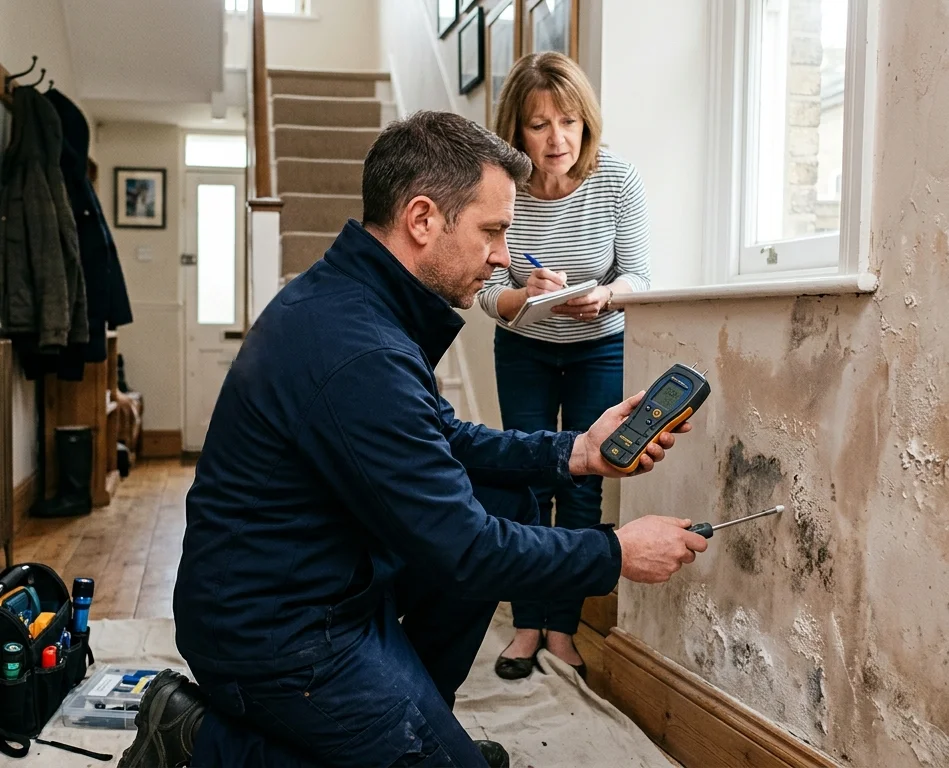
A follow-up inspection should consider both the timber and the building conditions around it.
This can help establish whether the decay is still active and whether the surrounding environment remains suitable for further deterioration.
| Inspection area | What may be assessed | Why it matters |
|---|---|---|
| Timber | Moisture content, condition and visible decay | Helps establish the extent of deterioration |
| Surrounding masonry | Dampness and staining | May indicate an ongoing moisture source |
| External walls | Pointing, render and defects | Water can enter through damaged external surfaces |
| Rainwater goods | Gutters and downpipes | Defects can keep timber exposed to moisture |
| Plumbing | Pipes and connections | Leaks can create persistent localised damp |
| Waterproofing | Membranes and junctions | May need review where water ingress is suspected |
| Previous repairs | Materials and affected areas | Helps establish what was already treated |
The findings should form the basis of any additional quotation.
What should a damp proofing quote in East London include?
A damp proofing quote east london property owners receive for corrective work should clearly explain the reason for the proposed treatment.
Rather than simply stating a lump sum, the quotation should ideally identify the affected areas and describe the work required.
Depending on the findings, this could include:
- Investigation and preparation
- Moisture-source correction
- Damp-proofing treatment
- Timber treatment
- Removal of damaged materials
- Replacement timber
- Waterproofing work
- Surface preparation
- Replastering or reinstatement
- Follow-up inspection or monitoring
The scope should distinguish between work that is necessary to address the moisture source and work that relates to repairing the resulting damage.
This distinction can make it easier to understand the total project and compare quotations.
How should persistent wet rot be assessed?
The condition of the timber is important, but so is the surrounding environment.
An assessment may consider whether the timber remains damp, whether decay is localised or more widespread and whether adjoining timber has also been affected.
Other factors can include ventilation, contact with masonry, water entry points and the condition of nearby finishes.
Where appropriate, local wet rot experts east london can assess the affected timber and consider whether treatment, repair or replacement is suitable.
Not every damaged timber component needs to be completely replaced. The appropriate approach depends on its condition, location, function and the extent of deterioration.
A follow-up inspection can help establish whether the timber needs additional treatment or whether the priority is correcting the moisture conditions around it.
What if dry rot is also found during follow-up work?
Wet rot and dry rot are different forms of timber decay and should not automatically be approached in the same way.
If an inspection identifies signs that are consistent with dry rot, the assessment may need to consider the extent of fungal activity, moisture conditions and any concealed areas that could be affected.
Where further work is required, dry rot repair services east london may form part of a wider remedial programme.
The quotation should explain what has been identified and whether the proposed work involves treatment, removal of affected timber or repair of associated building defects.
What affects the cost to fix wet rot?
Searches for the cost to fix wet rot can produce very broad figures because individual cases vary considerably.
The final cost depends on the condition and extent of the affected timber as well as the work needed to control the moisture source.
Important factors can include:
- Extent of timber deterioration
- Accessibility
- Whether timber is structural
- Amount of timber requiring repair or replacement
- Moisture-source correction
- Removal of damaged materials
- Treatment requirements
- Waterproofing or damp-proofing
- Surface reinstatement
- Follow-up monitoring
A localised timber repair may involve a relatively limited scope, while widespread decay combined with an ongoing water ingress problem can require considerably more work.
For this reason, a site-specific quotation is more useful than relying on a generic online average.
When could structural waterproofing be part of the corrective work?
Structural waterproofing may become relevant when recurring moisture is entering a below-ground or structurally enclosed part of a property.
For example, if timber deterioration is linked to water entering through a basement wall or floor, repairing the timber alone would not address the wider moisture problem.
A review may consider the condition of existing membranes, wall-floor junctions, penetrations and drainage arrangements.
Where further intervention is justified, structural waterproofing services east london can be considered as part of a broader remedial programme.
The proposed solution should be appropriate to the building and the identified source of water rather than simply selected because it was used on a previous project.
How much can structural waterproofing cost?
The structural waterproofing cost east london property owners face can vary substantially depending on the nature of the building and the extent of remedial work.
Factors that may influence the quotation include:
- Size of the affected area
- Existing waterproofing system
- Condition of walls and floors
- Access
- Preparation requirements
- Membrane repairs or replacement
- Drainage requirements
- Water pressure
- Number of junctions and penetrations
- Removal and reinstatement of finishes
A local repair and a complete waterproofing installation are very different projects, so a single benchmark figure may be misleading.
A detailed inspection should establish the extent of the problem before a final specification is prepared.
What should a corrective wet rot quotation explain?
A useful quotation should connect the diagnosis to the recommended work.
Property owners should be able to see:
What has been found: The affected timber and moisture source should be identified as clearly as possible.
What needs to be done: The quotation should explain whether the work involves treatment, repair, replacement or a combination.
Why it is needed: The relationship between the moisture source and timber deterioration should be explained.
What is included: Preparation, materials, labour, removal and reinstatement should be clear.
What is not included: Potential exclusions or additional work should be stated rather than left ambiguous.
How will the result be checked? Where appropriate, follow-up inspection or moisture monitoring may be recommended.
This level of detail can help prevent misunderstandings about the scope and final cost.
Can the moisture source be more important than the timber repair?
In many cases, yes.
If timber remains exposed to excessive moisture, a repaired or replaced section can face the same environmental conditions as the original material.
Corrective work should therefore consider the source of water as well as its effects.
For example, repairing a defective downpipe may be essential to prevent continued wetting of an external timber component. Likewise, addressing a plumbing leak can be necessary before timber repairs can provide a durable result.
This is why a quotation that only describes timber replacement may not tell the whole story.
Could further wet rot treatment be unnecessary?
It can be.
A follow-up inspection may establish that the original timber repair remains sound and that the current damp-looking area has another explanation.
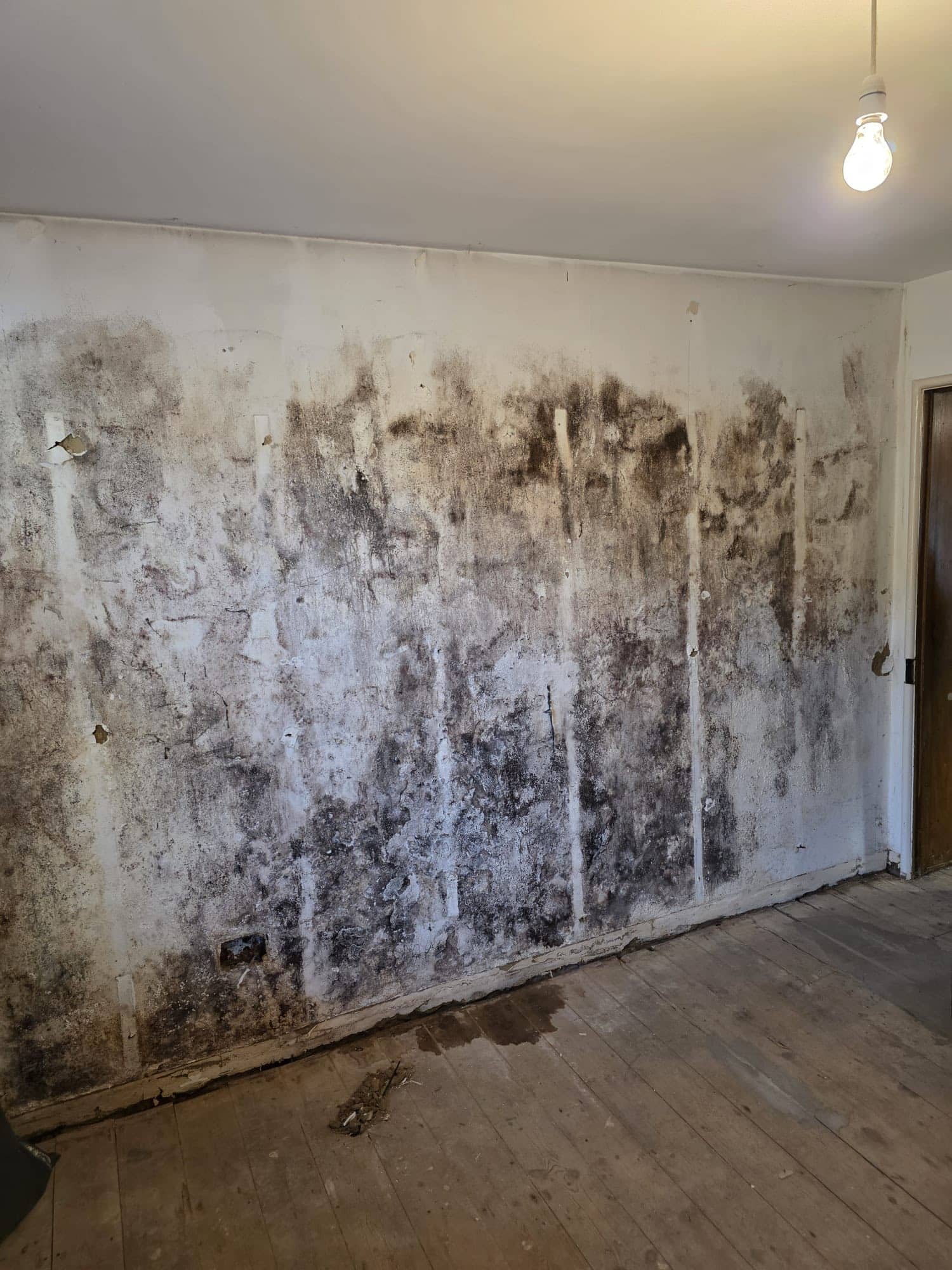
For example, surface staining may remain after the timber and surrounding structure have begun to dry. Alternatively, condensation could be contributing to a new patch of mould that is unrelated to the original wet rot.
Additional treatment should therefore follow an assessment of current conditions.
The objective should be to identify the cause and condition of the property rather than automatically repeating the previous remedial approach.
If wet rot symptoms have persisted after earlier repairs, a detailed assessment can help determine whether further timber work is required and what should be included in a corrective quotation.
A typical East London wet rot follow-up scenario
Consider a property where a section of timber was repaired after being affected by wet rot. Several months later, staining appears around the same area.
A follow-up inspection finds that the repaired timber itself is not showing widespread deterioration. However, a defective rainwater connection is allowing water to reach the surrounding structure during heavy rainfall.
The corrective programme may therefore focus first on addressing the external moisture source, followed by monitoring of the affected timber.
If additional decay is discovered, further timber repair can then be specified based on the evidence.
This approach avoids assuming that all recurring symptoms require the same treatment as the original problem.
How can property owners compare corrective quotations?
When comparing quotations, look beyond the headline price.
Two contractors may recommend different totals because their scopes of work differ. One quotation might include preparation and reinstatement, while another may cover only timber repair.
Check whether each quotation explains:
- The moisture source
- Affected timber
- Proposed treatment
- Repair or replacement requirements
- Waterproofing or damp-proofing
- Preparation
- Reinstatement
- Follow-up checks
- Warranty or guarantee information
- Exclusions
A transparent scope makes it easier to understand what you are actually paying for.
What should happen after corrective work?
Follow-up should not necessarily end when the physical repairs are completed.
Depending on the nature of the original problem, moisture levels may need to be monitored while materials dry and the building returns to more stable conditions.
Property owners should also understand whether any maintenance is recommended, particularly where drainage, rainwater goods or other external features contributed to the original problem.
Keeping records of the work can also be useful if the property requires another inspection in the future.
Related articles

What best describes you?

Homeowner

Tenant

Management/Lettings Agent

Potential Buyer

Other
At a glance
Wet rot is closely associated with persistent moisture, so repairing visibly damaged timber is only one part of addressing the problem. If the source of damp remains, timber can continue to deteriorate even after an earlier repair.
This is why a corrective quotation following wet rot repairs should explain more than the replacement of damaged timber. It should set out what has been found, where moisture is coming from, what needs to be repaired and how the proposed work is intended to prevent the same conditions from continuing.
A follow-up inspection can also identify whether the original repair needs extending or whether a separate moisture problem has developed since the first treatment.
Anke Damp Proofing can inspect persistent damp and timber problems, assess the condition of affected areas and explain what further remedial work may be appropriate.
Why can wet rot continue after repairs?
Wet rot can continue when timber remains exposed to conditions that allow fungal decay to develop.
Replacing a damaged section of timber without addressing the moisture source may therefore leave surrounding or replacement timber vulnerable.
Possible causes of persistent moisture include:
- Leaking gutters or downpipes
- Defective plumbing
- Water ingress through external walls
- Poor drainage
- Damaged pointing or render
- Condensation
- Defective waterproofing
- Groundwater or below-ground moisture
The first step in a corrective assessment is to establish whether the same moisture source is still present.
A return of staining does not automatically mean the previous repair was ineffective. It may indicate that conditions around the timber have changed or that another moisture pathway is involved.
What should be inspected before a corrective quotation is prepared?
A follow-up inspection should consider both the timber and the building conditions around it.
This can help establish whether the decay is still active and whether the surrounding environment remains suitable for further deterioration.
| Inspection area | What may be assessed | Why it matters |
|---|---|---|
| Timber | Moisture content, condition and visible decay | Helps establish the extent of deterioration |
| Surrounding masonry | Dampness and staining | May indicate an ongoing moisture source |
| External walls | Pointing, render and defects | Water can enter through damaged external surfaces |
| Rainwater goods | Gutters and downpipes | Defects can keep timber exposed to moisture |
| Plumbing | Pipes and connections | Leaks can create persistent localised damp |
| Waterproofing | Membranes and junctions | May need review where water ingress is suspected |
| Previous repairs | Materials and affected areas | Helps establish what was already treated |
The findings should form the basis of any additional quotation.
What should a damp proofing quote in East London include?
A damp proofing quote east london property owners receive for corrective work should clearly explain the reason for the proposed treatment.
Rather than simply stating a lump sum, the quotation should ideally identify the affected areas and describe the work required.
Depending on the findings, this could include:
- Investigation and preparation
- Moisture-source correction
- Damp-proofing treatment
- Timber treatment
- Removal of damaged materials
- Replacement timber
- Waterproofing work
- Surface preparation
- Replastering or reinstatement
- Follow-up inspection or monitoring
The scope should distinguish between work that is necessary to address the moisture source and work that relates to repairing the resulting damage.
This distinction can make it easier to understand the total project and compare quotations.
How should persistent wet rot be assessed?
The condition of the timber is important, but so is the surrounding environment.
An assessment may consider whether the timber remains damp, whether decay is localised or more widespread and whether adjoining timber has also been affected.
Other factors can include ventilation, contact with masonry, water entry points and the condition of nearby finishes.
Where appropriate, local wet rot experts east london can assess the affected timber and consider whether treatment, repair or replacement is suitable.
Not every damaged timber component needs to be completely replaced. The appropriate approach depends on its condition, location, function and the extent of deterioration.
A follow-up inspection can help establish whether the timber needs additional treatment or whether the priority is correcting the moisture conditions around it.
What if dry rot is also found during follow-up work?
Wet rot and dry rot are different forms of timber decay and should not automatically be approached in the same way.
If an inspection identifies signs that are consistent with dry rot, the assessment may need to consider the extent of fungal activity, moisture conditions and any concealed areas that could be affected.
Where further work is required, dry rot repair services east london may form part of a wider remedial programme.
The quotation should explain what has been identified and whether the proposed work involves treatment, removal of affected timber or repair of associated building defects.
What affects the cost to fix wet rot?
Searches for the cost to fix wet rot can produce very broad figures because individual cases vary considerably.
The final cost depends on the condition and extent of the affected timber as well as the work needed to control the moisture source.
Important factors can include:
- Extent of timber deterioration
- Accessibility
- Whether timber is structural
- Amount of timber requiring repair or replacement
- Moisture-source correction
- Removal of damaged materials
- Treatment requirements
- Waterproofing or damp-proofing
- Surface reinstatement
- Follow-up monitoring
A localised timber repair may involve a relatively limited scope, while widespread decay combined with an ongoing water ingress problem can require considerably more work.
For this reason, a site-specific quotation is more useful than relying on a generic online average.
When could structural waterproofing be part of the corrective work?
Structural waterproofing may become relevant when recurring moisture is entering a below-ground or structurally enclosed part of a property.
For example, if timber deterioration is linked to water entering through a basement wall or floor, repairing the timber alone would not address the wider moisture problem.
A review may consider the condition of existing membranes, wall-floor junctions, penetrations and drainage arrangements.
Where further intervention is justified, structural waterproofing services east london can be considered as part of a broader remedial programme.
The proposed solution should be appropriate to the building and the identified source of water rather than simply selected because it was used on a previous project.
How much can structural waterproofing cost?
The structural waterproofing cost east london property owners face can vary substantially depending on the nature of the building and the extent of remedial work.
Factors that may influence the quotation include:
- Size of the affected area
- Existing waterproofing system
- Condition of walls and floors
- Access
- Preparation requirements
- Membrane repairs or replacement
- Drainage requirements
- Water pressure
- Number of junctions and penetrations
- Removal and reinstatement of finishes
A local repair and a complete waterproofing installation are very different projects, so a single benchmark figure may be misleading.
A detailed inspection should establish the extent of the problem before a final specification is prepared.
What should a corrective wet rot quotation explain?
A useful quotation should connect the diagnosis to the recommended work.
Property owners should be able to see:
What has been found: The affected timber and moisture source should be identified as clearly as possible.
What needs to be done: The quotation should explain whether the work involves treatment, repair, replacement or a combination.
Why it is needed: The relationship between the moisture source and timber deterioration should be explained.
What is included: Preparation, materials, labour, removal and reinstatement should be clear.
What is not included: Potential exclusions or additional work should be stated rather than left ambiguous.
How will the result be checked? Where appropriate, follow-up inspection or moisture monitoring may be recommended.
This level of detail can help prevent misunderstandings about the scope and final cost.
Can the moisture source be more important than the timber repair?
In many cases, yes.
If timber remains exposed to excessive moisture, a repaired or replaced section can face the same environmental conditions as the original material.
Corrective work should therefore consider the source of water as well as its effects.
For example, repairing a defective downpipe may be essential to prevent continued wetting of an external timber component. Likewise, addressing a plumbing leak can be necessary before timber repairs can provide a durable result.
This is why a quotation that only describes timber replacement may not tell the whole story.
Could further wet rot treatment be unnecessary?
It can be.
A follow-up inspection may establish that the original timber repair remains sound and that the current damp-looking area has another explanation.
For example, surface staining may remain after the timber and surrounding structure have begun to dry. Alternatively, condensation could be contributing to a new patch of mould that is unrelated to the original wet rot.
Additional treatment should therefore follow an assessment of current conditions.
The objective should be to identify the cause and condition of the property rather than automatically repeating the previous remedial approach.
If wet rot symptoms have persisted after earlier repairs, a detailed assessment can help determine whether further timber work is required and what should be included in a corrective quotation.
A typical East London wet rot follow-up scenario
Consider a property where a section of timber was repaired after being affected by wet rot. Several months later, staining appears around the same area.
A follow-up inspection finds that the repaired timber itself is not showing widespread deterioration. However, a defective rainwater connection is allowing water to reach the surrounding structure during heavy rainfall.
The corrective programme may therefore focus first on addressing the external moisture source, followed by monitoring of the affected timber.
If additional decay is discovered, further timber repair can then be specified based on the evidence.
This approach avoids assuming that all recurring symptoms require the same treatment as the original problem.
How can property owners compare corrective quotations?
When comparing quotations, look beyond the headline price.
Two contractors may recommend different totals because their scopes of work differ. One quotation might include preparation and reinstatement, while another may cover only timber repair.
Check whether each quotation explains:
- The moisture source
- Affected timber
- Proposed treatment
- Repair or replacement requirements
- Waterproofing or damp-proofing
- Preparation
- Reinstatement
- Follow-up checks
- Warranty or guarantee information
- Exclusions
A transparent scope makes it easier to understand what you are actually paying for.
What should happen after corrective work?
Follow-up should not necessarily end when the physical repairs are completed.
Depending on the nature of the original problem, moisture levels may need to be monitored while materials dry and the building returns to more stable conditions.
Property owners should also understand whether any maintenance is recommended, particularly where drainage, rainwater goods or other external features contributed to the original problem.
Keeping records of the work can also be useful if the property requires another inspection in the future.
Related articles
What best describes you?
Homeowner
Tenant
Management/Lettings Agent
Potential Buyer