

Why Should Timber Be Checked Before Plastering?
Plastering is often one of the stages that makes a refurbishment feel as though it is finally coming together. Walls are prepared, surfaces become smooth and the property starts to look finished.
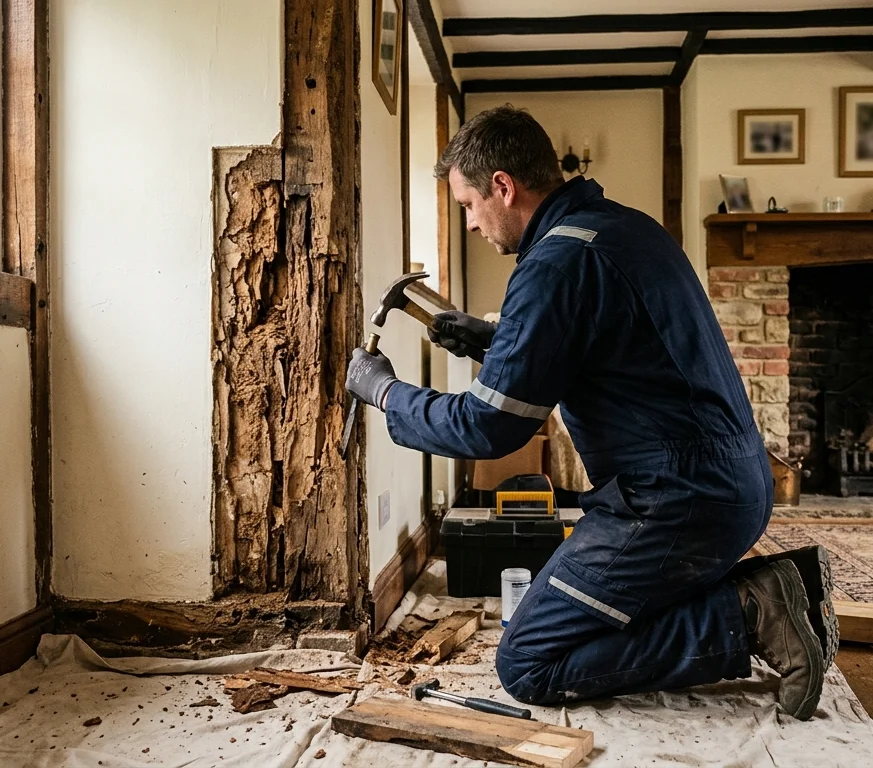
However, plaster should not be used to cover up unresolved moisture or timber problems. In older and altered properties, timber can sit behind walls, beneath floors or around openings where previous leaks and damp conditions may have gone unnoticed.
Once plaster and other finishes are installed, accessing concealed timber becomes considerably harder. If decay is discovered later, newly completed areas may have to be opened up again.
A timber check before plastering can therefore be a sensible part of refurbishment planning, particularly where there has been a history of damp, leaks or water ingress.
If your refurbishment has exposed damaged or suspicious timber, contact Anke Damp Proofing before plastering continues so the condition can be assessed properly.
What Timber Problems Can Appear During a Refurbishment?
Stripping a property back often reveals defects that were hidden by paint, plaster, flooring or previous repairs.
Timber may show signs of moisture exposure without necessarily having active fungal decay. In other cases, prolonged damp conditions can lead to wet rot or dry rot.
Potential warning signs include:
- Dark or unusual timber staining
- Softened or weakened timber
- Crumbling areas
- Cracks or changes in timber structure
- Fungal growth
- Musty smells
- Evidence of previous leaks
- Damp masonry around timber
- Deteriorated skirting boards
- Timber close to poorly ventilated areas
The appearance of one symptom does not automatically establish the cause. A timber element that looks dark may have historic staining, while apparently minor deterioration may deserve closer investigation.
The important point is to check before the affected area disappears behind new finishes.
What Is the Difference Between Wet Rot and Dry Rot?
Wet rot and dry rot are both associated with fungal decay, but they are not identical problems.
Wet rot generally develops where timber remains persistently damp. It is often closely linked to the moisture source, although the extent of deterioration can vary.
Dry rot can behave differently. Under suitable conditions, the fungus can spread through a building and affect timber beyond the point where the original moisture problem was first noticed.
| Timber issue | Typical association | What should be considered? |
| Wet rot | Persistent moisture affecting timber | Moisture source and condition of timber |
| Dry rot | Moisture with suitable conditions for fungal spread | Extent of decay and moisture conditions |
| Historic staining | Previous moisture exposure | Whether deterioration is still active |
| Mechanical damage | Physical deterioration | Structural condition and cause |
| Insect damage | Timber affected by wood-boring insects | Extent and type of damage |
This is a general guide rather than a diagnosis. Similar-looking symptoms can have different causes, so timber should be assessed in context.
Could Plastering Hide a Timber Problem?
Yes. Plaster can conceal timber around wall edges, openings and structural junctions. It can also make future inspection more difficult.
For example, an old leak near a window may have affected the surrounding timber. If the wall is replastered without checking the area, any deterioration could remain concealed until the new finish begins to fail.
The same principle applies to areas around bathrooms, kitchens and external walls. If timber has been exposed to moisture, it is worth considering whether the source has been resolved before the surface is closed again.
This does not mean every refurbishment requires extensive timber removal. It means areas with a known moisture history should not be covered without appropriate consideration.
What best describes you?

Homeowner

Tenant

Management/Lettings Agent

Potential Buyer

Other
It just takes 60 Second
And then you can book a free consultation
When Should Rot Checks Take Place?
Timing matters. Ideally, timber should be checked once relevant finishes have been removed but before plastering, flooring and joinery permanently restrict access.
A typical refurbishment sequence might involve:
- Removing old finishes.
- Identifying areas with previous damp or water exposure.
- Inspecting accessible timber.
- Establishing whether deterioration is present.
- Identifying moisture sources.
- Carrying out appropriate remedial work.
- Allowing affected areas to reach suitable conditions.
- Completing plastering and other finishes.
This sequence can reduce the likelihood of discovering a hidden defect after the renovation has already progressed.
It is especially relevant when a property has experienced leaks, penetrating moisture or repeated damp staining.
What Happens If Dry Rot Is Suspected?
If dry rot is suspected, the first step should be a proper assessment rather than immediately removing everything that looks affected.
The investigation should consider the extent of visible deterioration, nearby timber, moisture conditions and potential reasons for the problem developing.
Depending on the findings, dry rot treatment east london may involve addressing the moisture source, removing timber that cannot be retained, treating appropriate areas and replacing affected components.
The work should be proportionate to the actual condition of the building. Not every dark or damaged piece of timber has the same significance.
Why Must the Moisture Source Be Addressed?
Treating damaged timber without addressing the reason it became damp can leave the property vulnerable to further deterioration.
Possible sources include:
- Leaking plumbing
- Defective roofs
- Damaged gutters
- Poor drainage
- Water penetration through external walls
- Defective window details
- Condensation
- Previous flooding
The correct solution depends on the circumstances. If water continues to reach timber, simply replacing the visibly damaged section may not solve the wider problem.
This is why dry rot repair services east london should involve consideration of the surrounding moisture conditions as well as the affected timber.
If your refurbishment has uncovered timber deterioration, speak to our team before plastering or closing the area. Early investigation can make it easier to understand the extent of the work required.
Can Wet Rot Be Treated Without Replacing Everything?
Sometimes. The appropriate approach depends on the severity of deterioration, the condition of the timber and whether the moisture source can be controlled.
Where timber has retained sufficient integrity, it may be possible to address the cause of moisture and carry out suitable repairs. Severely deteriorated timber may require partial or complete replacement.
Wet rot treatment east london should therefore be based on the actual condition of the timber rather than the presence of staining alone.
For renovation projects, it is particularly useful to establish this before new finishes are installed. It gives homeowners and contractors a clearer picture of what needs to be done and reduces the chance of unnecessary removal later.
A Typical East London Refurbishment Scenario
Imagine a traditional terraced property undergoing a full internal refurbishment. The owners intend to replaster the ground floor, install a new kitchen and replace the flooring.
When old plaster is removed around the kitchen area, sections of timber appear darker than expected. There has also been a previous plumbing leak in the same part of the property.
Instead of plastering over the area, the timber is checked. The assessment identifies deterioration associated with historic moisture exposure, while the plumbing issue is also addressed.
The affected timber is then dealt with as appropriate before the walls are closed and the renovation continues.
The benefit is straightforward: the issue was dealt with while access was available, rather than after the kitchen and new finishes had been installed.
What Should You Ask Before New Plaster Goes On?
Before closing up walls, ask a few practical questions:
- Has any timber been exposed during stripping-out?
- Has the area previously suffered from leaks or damp?
- Is there visible staining or deterioration?
- Has the moisture source been identified?
- Is the timber structurally sound?
- Is further investigation required?
- Does any damaged material need repair or replacement?
- Has the affected area been adequately addressed before plastering?
Keeping photographs at this stage is also worthwhile. Once the plaster is finished, the condition of the underlying area will no longer be visible.
How Can Early Rot Checks Protect a Refurbishment Budget?
Hidden timber deterioration can create unexpected costs when discovered late in a project.
If a problem is identified before plastering, flooring and fitted furniture are installed, the work can often be planned alongside the wider refurbishment. If it is discovered afterwards, access may require finished surfaces to be removed.
The cost of dry rot treatment east london will vary according to the extent of the problem and the work required. A small localised repair is clearly different from widespread decay requiring extensive access and replacement.
For this reason, a timely assessment can provide useful information for budgeting, even when no major treatment is ultimately required.
Check the Timber Before You Close the Walls
A refurbishment is a valuable opportunity to inspect parts of a property that have been hidden for years. Once plaster, flooring and joinery are installed, access becomes more difficult and future repairs can become more disruptive.
Checking timber where there is a history of moisture, investigating suspicious deterioration and addressing the underlying cause can help the renovation progress with fewer surprises.
If you have uncovered damaged timber during an East London refurbishment, contact Anke Damp Proofing for practical advice. Our team can help establish whether dry rot repair services east london or dry rot treatment east london is appropriate for the property.